Love Is a Survival Code, Not a Mood.
In the 1950s, a British psychiatrist named John Bowlby was studying orphans after the war and noticed something the field had missed. Babies separated from their caregivers didn't just get sad. They panicked, then shut down, then sometimes stopped growing. Connection, Bowlby argued, was as biologically essential as food.
For decades, this "attachment theory" stayed locked in the nursery. Adults were supposed to be independent, self-contained, above such needs. Then Johnson noticed the couples in her office were doing the same dance as Bowlby's babies. Reaching, protesting, freezing. She called what she saw effective dependency — the counterintuitive truth that adults who can lean on one partner deeply are actually the strongest, most resilient, most independent people around.
When that bond feels threatened, the amygdala fires an alarm the neuroscientist Jaak Panksepp called primal panic. Your heart races, your logic evaporates, and suddenly you're screaming about a coffee mug. It isn't about the mug. It's your body detecting emotional distance and treating it like a medical emergency — because, biologically, that's exactly what it is.
The A.R.E. Test Every Relationship Silently Runs.
Ask yourself three questions about your partner. Can I reach you? Can I count on you to respond when I do? Do you value me and stay close? That's the A.R.E. test — Accessibility, Responsiveness, Engagement — and Johnson says every human is running it, mostly unconsciously, every day of their relationship.
Notice what's missing from that test. Nothing about communication techniques. Nothing about compatibility scores or love languages or date-night frequency. The researcher John Gottman spent decades filming couples and found the same thing from another angle: what predicted lasting love wasn't the absence of conflict, but the presence of emotional responsiveness during it.
When the A.R.E. answer is yes, small fights stay small. When it turns to no, even a raised eyebrow can feel like abandonment. That's why couples counseling that teaches "I-statements" so often fails. You can't script your way out of a bond that feels unsafe. You have to make it safe first.
The Three Demon Dialogues.
When safety slips, couples fall into what Johnson calls the Demon Dialogues — negative loops that feel spontaneous but are actually as choreographed as a tango. She names three.
The first is Find the Bad Guy: attack and counter-attack, both partners hurling blame, each convinced the other is the problem. Nobody wins because nobody's really trying to; both are just trying to stop feeling like the villain. The second, and by far the most common, is the Protest Polka. One partner pushes, criticizes, demands — that's the protest against disconnection. The other pulls back, goes quiet, tries to smooth things over. The more one pushes, the more the other retreats, and the whole thing spins faster.
The third is the deadliest: Freeze and Flee. Both partners give up protesting. The house goes quiet. Everything looks fine from the outside. But inside, two people are living as roommates. Johnson's key move is to help couples name the dance itself as the enemy. Not him. Not her. The pattern. Once you see the polka, you can stop dancing it.
Raw Spots and Why You Overreacted.
You know that moment when your partner says something small — "Did you forget again?" — and you erupt like they stabbed you? That's a Raw Spot getting touched. Raw Spots are hypersensitive places built from every earlier moment you felt emotionally deprived or deserted. Johnson calls these the 2 Ds: deprived of care, or deserted when you needed someone most.
Maybe your mother worked three jobs and you learned not to ask. Maybe an ex disappeared during your father's illness. Maybe a friend group closed ranks in middle school and you've been on guard ever since. Your partner didn't cause the Raw Spot, but a careless comment can land right on it, and your reaction will feel wildly out of proportion — because you're not just reacting to today.
The way out is Revisiting a Rocky Moment together. Not to relitigate who was right, but to slow down and ask: what got triggered under the anger? What old ache made me snap? When couples stop debating the facts and start mapping the wounds, the fight loses its fuel. You take ownership of your defensive moves, name your Raw Spot, and let your partner see what actually hurt.
The Vulnerability Leap.
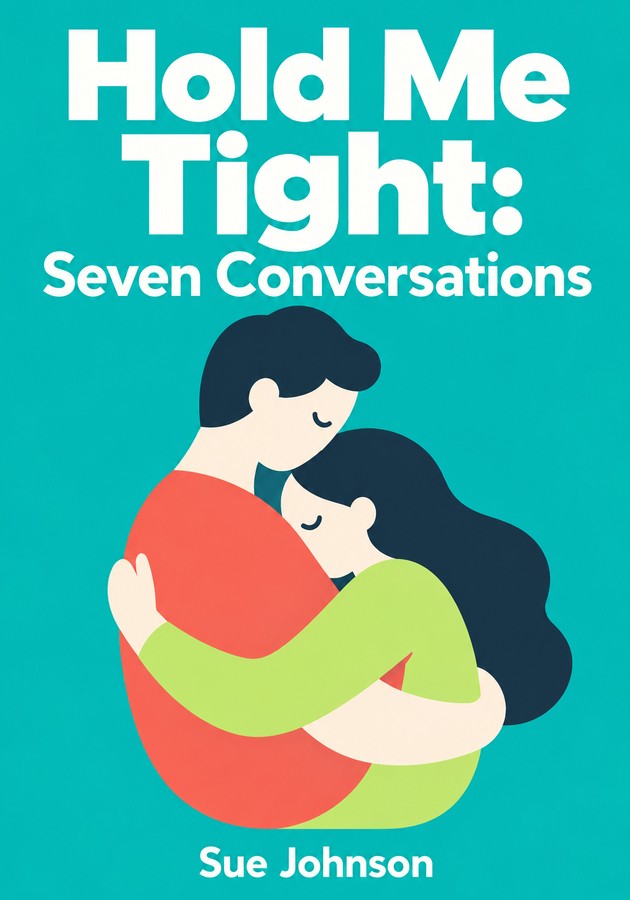
This is the conversation everything else has been building toward. Johnson calls it Hold Me Tight, and it turns on two questions that most couples have never truly asked each other. What am I most afraid of? And what do I need most from you?
Not "I need you to take out the trash." That's a task. The attachment ask is deeper. I'm afraid you'll stop finding me interesting. I need to know I still matter to you. I'm afraid I'll never be enough. I need you to tell me when I am. These sentences feel almost impossible to say. Every instinct screams to protect yourself, stay armored, don't hand someone the knife.
But when one partner leaps and the other catches — really catches, with soft eyes and open arms — something biochemical happens. Mirror neurons fire, syncing the emotional state of both brains. Oxytocin, the bonding hormone, floods the system. The nervous system that was in primal panic ten minutes ago starts to settle. This is why an eight-minute conversation, done right, can shift a relationship more than a year of arguing about logistics.
The Six Steps to Forgive a Real Wound.
Some hurts don't fade with time. An affair. A missed hospital visit. The moment your partner sided with their mother during your worst week. Johnson calls these relationship traumas, and she found that couples can't just move past them — the wound gets encoded as evidence that this person isn't safe, and every future intimacy hits that scar.
Forgiving Injuries takes six deliberate steps. The hurt partner names the pain without weaponizing it. The one who caused it stays present instead of getting defensive, and truly acknowledges the impact — not "I'm sorry you feel that way," but "I see what I did and how it broke something." Then comes the reversal of what Johnson calls the Never Again rule, the invisible vow the wounded partner made to never be that exposed again. A genuine apology follows. Then a specific request for comfort. Finally, together, the couple writes a new story about what happened and what it means going forward.
Skipping steps doesn't work. Neither does time alone. The wound has to be witnessed.
From Sealed-Off Sex to Synchrony Sex.
Sex is where all this either lands or shatters. Johnson identifies three modes couples fall into. Sealed-Off Sex is mechanical — focused on performance, orgasm, technique, with emotional walls firmly up. It can feel good in the moment but corrodes intimacy over time. Solace Sex is anxious — driven by the need to prove you're still wanted, still attractive, still chosen. Every touch is asking a question.
Then there's Synchrony Sex. This is what happens when emotional safety is established first, when both partners feel accessible and responsive outside the bedroom. Vulnerability becomes exciting instead of dangerous. Play becomes possible. Physical touch, which is a biological imperative for adult bonding — not a bonus feature — starts doing what it's designed to do: deepening the bond that then makes the next encounter even more open. Good emotional connection creates good sex, and good sex deepens the emotional connection. The loop runs in the right direction for once.
Daily Rituals and the Trauma Dragon.
A secure bond isn't a monument you build once. It's a garden. Johnson urges couples to design deliberate daily rituals — the six-second kiss goodbye, the twenty-minute download when you get home, the phone call before boarding a flight. These aren't cheesy. They're the neural duet your brain uses to keep confirming: we're still here, we're still us.
Beyond the daily, Johnson has couples write two stories together. A Resilient Relationship Story looks backward and names the storms you've already survived as a team, cementing the evidence that you can handle hard things. A Future Love Story looks forward, mapping the shared dreams — the trip to Kyoto, the garden, the grandkids you want to be able to run after — so the bond has direction, not just history.
And when life sends a real Dragon — a diagnosis, a job loss, a violence survived — the instinct to isolate "so I don't burden them" is exactly wrong. Survivors who face the dragon alone tend to spiral. Those who let their partner in heal faster, and the relationship gets stronger through the fire. The cuddle hormone oxytocin, released by close physical contact, literally helps the brain process fear. Your partner is not a distraction from healing. They are the healing.
The Ripple.
Absolute independence is a cultural lie. Secure mutual dependence is the biology. And when two people learn to hold each other tight, their kids learn it, their friends feel it, their coworkers absorb it. Empathy ripples outward from bonded couples into a kinder world.
That's the real promise. Lean in. Name the dance. Ask the scary question. Let yourself be caught.