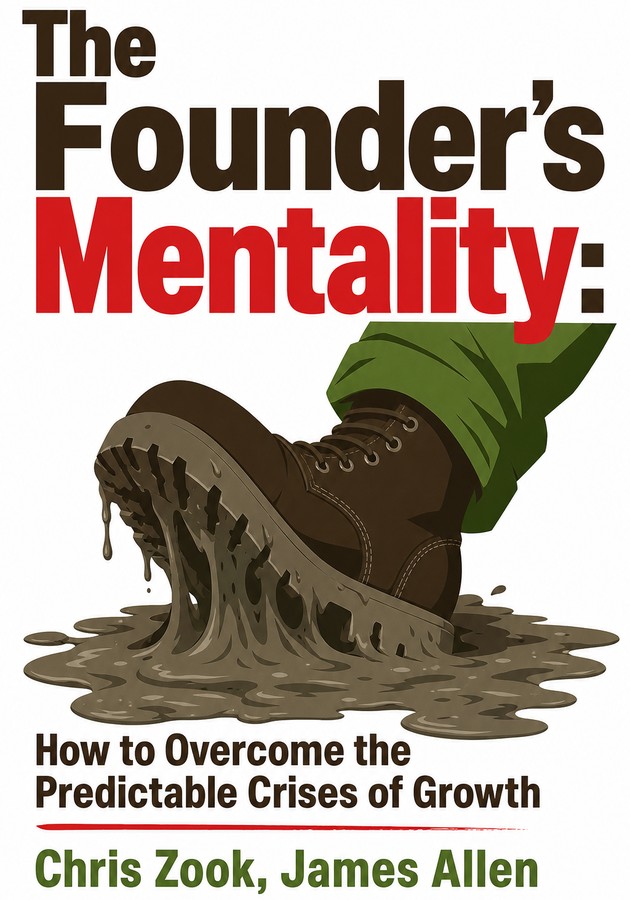
Two sets of forces drive this. What the authors call Westward Winds carry a young insurgent toward incumbency: the founder who can't scale, the front line nobody listens to anymore, accountability that blurs as headcount grows faster than talent. Southward Winds push the incumbent toward bureaucracy: complexity feeding on itself, matrix structures where everyone is consulted and nobody decides, a customer experience split across departments, a mission that quietly dies. Name the wind you're caught in, and the problem stops being a mystery.
What Founders Do That Managers Forget
Companies that keep growing share three habits. The first is an insurgent mission — a bold, specific fight on behalf of a customer the industry is failing. Yonghui Superstores built itself in China around fresh produce sold at prices and quality the old grocery chains couldn't match. That wasn't a slogan. It was a declaration of war with a shopping cart.
The second is an obsession with the front line. At the Oberoi Group, the luxury hotel chain, employees aren't trained to escalate problems upward. They're trusted to solve them where the guest is standing, because the details of the experience are the business. The third is an owner's mindset: hatred of waste, bias for action, allergy to bureaucracy. At AB InBev, people are taught to behave like restaurant owners, not waiters — a waiter delivers an order, an owner notices the empty table and does something about it.
Zook and Allen plot these ideas on what they call the Founder's Mentality Map, weighing the advantages of size against the advantages of that founder energy. Most big companies drift toward stable incumbent or struggling bureaucracy. The prize sits in the other corner: the scale insurgent, large enough to win and hungry enough to move.
When Fast Growth Becomes Chaos
Norwegian Cruise Line had a genuinely disruptive idea called Freestyle Cruising — no fixed dining times, no assigned tables, no formal dress codes. Customers loved the promise. The operation buckled under it. Kitchens, staffing, and scheduling were built for the old way, so the experience varied wildly from ship to ship.
Kevin Sheehan's turnaround didn't start with a new idea. It started with making the existing one actually work, ship by ship, detail by detail, with the crew. That's the pattern for Overload: heroics are not a strategy. Individual effort has to be backed by routines that don't depend on anyone being a hero at 2 a.m.
Harsh Mariwala, who built the Indian consumer-products company Marico, did something similar with purpose. Instead of writing the values himself and mailing them out, he put them through his team until they belonged to everyone. Yonghui went further and attacked its own model, opening experimental "green stores" to disrupt the established "red store" format before a competitor could. And to keep resources from calcifying, companies like AB InBev rebuild budgets from scratch each year — zero-based budgeting, where every expense has to earn its place again. Growing fast is survivable. Growing fast on autopilot is not.
Curing the Bureaucracy Disease
The Home Depot under Robert Nardelli is the textbook Stall-Out. He centralized, standardized, and measured relentlessly. The numbers looked disciplined. Meanwhile the store managers — the people who actually knew the customers and the orange aprons — lost their authority, and the service that built the brand eroded.
Frank Blake took over and reversed the flow. He pushed decisions back toward the stores, cut tasks that stole time from the aisles, and treated the front line as the center of the company rather than the end of a reporting chain. Cisco ran a parallel battle against internal drag with its Accelerated Cisco Transformation effort, stripping out complexity so the organization could move again. At 3M, George Buckley sold off businesses that didn't belong and gave engineers back the protected time for personal projects that had produced the company's best inventions.
Then there's the oxygen trick: bring founders in from outside. John Donahoe at eBay bought a string of small, founder-led companies, less for the products than for the people and the instincts that came with them. Complexity never leaves on its own. Somebody has to walk in and cut it.
Refounding a Business in Free Fall
Free Fall is different. It isn't a slowdown, it's an existential drop, usually triggered when the outside world changes faster than the business model. Charles Schwab came back as CEO during the dot-com bust and did the hardest thing first: he replaced more than 70% of his top management, because the people who authored the failing strategy rarely bury it.
Then comes radical focus on the core of the core. Jørgen Vig Knudstorp found LEGO near collapse, spread across theme parks, video games, and clothing. He shed the adjacencies and returned the company to the brick. Crown Castle, the cell tower business, redefined its insurgency altogether, trading a global land grab for dense regional networks and obsessive customer service.
And sometimes the refounding is cultural. Kent Thiry inherited the near-bankrupt Total Renal Care, renamed it DaVita, and rebuilt it around the idea of a village — a community with shared values where clinic teams owned outcomes. Patients noticed, because employees did. A company in free fall doesn't need a clever plan. It needs to be founded again, by people willing to say the old answer is dead.
A Compass Beats a Rulebook
Scale makes alignment hard. The answer isn't a thicker policy manual; it's a compass. When Paul Polman set out to turn Unilever around, he used a short, plain document — the Unilever Compass — that stated what the company was for and which principles were non-negotiable. A compass travels well. A rulebook only works where it was written.
Leaders who hold companies together at size also think in a particular way. The authors describe Janusian thinking: holding two opposing truths at once, like cutting costs while investing in growth, or standardizing globally while adapting locally. Most executives pick one and call it clarity. The good ones refuse the trade.
They also understand what the authors call the power of 10X. Scattering money across forty small bets rarely changes anything. Concentrating it into a few large, spiky investments in the capabilities you genuinely lack is what moves a business. That means saying no constantly — to the attractive adjacency, to the pet project, to the deal that would dilute the core. Focus isn't the absence of ambition. It's ambition that chose.
Guarding Speed Where You Stand
Speed dies in small, invisible ways. An extra approval here. A report nobody reads. A meeting that exists because it has always existed. These hidden killers of speed don't announce themselves, and no single one is worth a fight — which is exactly why they accumulate until a decision that should take a day takes a quarter.
Here's the part that matters for you specifically: none of this requires a corner office. Jabo Floyd ran a Walmart distribution center. He didn't wait for a corporate program or a memo from headquarters. He started behaving like an owner of his own operation, listening to his people, clearing obstacles, holding a clear mission for his site, and treating the company's money as his own. Results followed, inside a company of more than a million employees.
That's the whole argument of this microbook in one man. The founder's mentality is not inherited with equity; it's a way of showing up. When enough people choose it, the organization stops being a hierarchy with insurgents trapped inside it and becomes what Zook and Allen call a company of insurgents.
Final notes
Sustainable growth isn't found in a new market. It's protected, inside, by leaders who refuse to let scale become an excuse. Strip the layers, hand authority back to the people touching customers, spend every dollar like it left your own pocket — and an aging giant remembers how to be hungry. The size of your company should never set the speed of your decisions.