He takes this pride with him to the University College at Fort Hare where he starts learning Lincoln’s speeches by heart, and where he challenges authority for the first time. Moreover, in his second year there, he supports a student boycott and is expelled from the school because of this.
About this time, Mandela’s regent arranges marriages for both him and his friend Justice, but they decide to flee to Johannesburg to escape the bondage of being forced into marriage.
They arrive there in 1941. The world is already at war. But Mandela is about to start a different one.
The birth of a freedom fighter
In Johannesburg Mandela gets a job as a night watchman in a gold mine, but pursues law studies in his free time. Thanks to a lifelong friend of his, who he met in Johannesburg, Mandela gets a job as an articled clerk with lawyer Lazar Sidelsky.
Sidelsky, a White Jewish South African, warned Mandela not to enter the world of politics, but it is too late for Nelson: through Sisulu and his colleague, Gaur Radebe, Mandela becomes a member of the African National Congress (ANC), the oldest organization of its kind in the country.
In addition, Mandela befriends activists Harold Wolpe and Tony Dowd, as well as numerous members of the Communist Party in South Africa. In 1943, he becomes an active participant in a bus boycott, and a year later, he is one of the people responsible for the establishment of a Youth League within the ANC.
At the end of 1944, he marries Evelyn Mase, a nurse, who will end up giving birth to four of Mandela’s six children, before divorcing him in 1958.
Looking back, the latter event was all but inevitable: fully dedicated to his political activism, as the years went by, Mandela started spending less and less time with his wife, who, in turn, had become a Jehovah’s Witness in the meantime and “didn't want to hear a thing about politics.”
However, after 1948, there was nothing but politics on Mandela’s mind, because that was the year that Daniel François Malan’s National Party won the general election in South Africa, and started, almost immediately, to implement the system of apartheid, i.e., institutionalized racial segregation.
Mandela and the Youth League tried fighting back: on June 26, 1950, as their answer to the murder of 18 Africans and the passage of the Suppression of Communism Act, they urged all African workers to stay at home.
The so-called National Day of Protest was a success, and, soon enough, the number of ANC members increased significantly.
The fight was on.
High treason and the Black Pimpernel
Four days after the National Day of Protest, Mandela and a few other members of the ANC are arrested for violating the Suppression of Communism Act.
On December 2, they are all found guilty of something called “statutory communism” and sentenced to nine months in prison. However, the sentence is suspended for two years, during which Mandela could go on about his daily activities.
In 1952, he even starts his own law firm, which focuses mainly on helping Africans in trouble. There were many of them during the first years of the Apartheid, blamed for all kinds of things that had been legal until very recently.
The situation gets worse with every passing month, and the ANC starts debating the need for violence. Sisulu and Mandela believed that without any violent acts, the Apartheid laws might never be overturned, and Sisulu even tries to secretly visit China and ask from its communist government to provide the ANC with weapons.
On December 5, 1956, Mandela is arrested yet again, this time for high treason. The star witness of the prosecution, a certain Solomon Ngubase, retells the story above (with USSR instead of China), but during his cross-examination, the defense demonstrates that he was never a member of the ANC, nor (as he had claimed) a university graduate.
In the end, the judge acquits all of the accused, stating that the evidence for high treason and a violent plot provided by the state is insufficient in this case.
Outside the courtroom, things get even uglier. On March 26, 1960, during a peaceful protest against the “pass laws” (which required all Africans to carry passbooks everywhere outside their own neighborhoods), the police open fire at the demonstrators and kill at least 69 innocent people.
Unsurprisingly, the violence debate within the ANC wasn’t a debate anymore. Even though, officially, the organization maintained a policy of non-violence, it allowed Mandela, freshly freed, to create a militant organization within it.
The organization, called Umkhonto we Sizwe (The Spear of the Nation)—or MK for short—bought the Liliesleaf Farm in Rivonia, a small suburb of Johannesburg, and it was there that Mandela moved soon after being acquitted.
Rivonia and Robben Island
The Liliesleaf Farm in Rivonia served as a training ground for the MK, which made its presence known soon after being founded.
On December 16, 1960—the day when the great Zulu leader Dingane (brother of Shaka) was defeated by the white South Africans—the organization detonated a few homemade bombs at electric power stations and government offices in Johannesburg, Port Elizabeth, and Durban.
“Afrikaners celebrate December 16 as the triumph of the Afrikaner over the African and the demonstration that God was on their side,” writes Mandela, “while Africans mourned this day of the massacre of their people. We chose December 16 to show that the African had only begun to fight, and that we had righteousness—and dynamite—on our side.”
At the time of the explosions, thousands of leaflets with the new MK manifesto are circulated all over the country, claiming that the time to choose between submission and fight has come and that the Africans have chosen the latter.
The government is taken by surprise, but it wastes no time to retaliate. On August 5, 1962, Mandela is arrested for the third time, and two years later, together with eight other members of the MK, he is found guilty of all charges and sentenced to life imprisonment by Judge Quartus de Wet during the infamous “Rivonia Trial.”
Mandela’s defiance during the trial makes him an international hero. He admits to having broken the laws, but he also claims that he is not morally bound by them since they had been passed by a parliament for whose election he was not even allowed to vote—by those very same laws.
Excerpts of Mandela’s speech were published in many international newspapers, and perhaps this is one of the reasons why he didn’t get the death penalty, which was not only a possibility, but the most probable outcome in cases of high treason.
Mandela spent the next 18 years of his life in the maximum-security prison on Robben Island, where he was forced to spend most of his days either inside a nearly uninhabitable minuscule cell, or breaking large stones with a small hammer.
Since Mandela was one of the prisoners kept under the strictest control, he was allowed only two visitors and as many letters per year. And even these letters were read and censored by his guards, one of whom, James Gregory, would eventually use this knowledge to write a book titled Goodbye Bafana.
Talking with the enemy and freedom
With time, the guards became less strict toward the prisoners, and the prisoners more hopeful. Outside, however, the situation was only getting worse.
Inspired by the sabotage acts of the MK, the new generations of African fighters weren’t interested in debating anything with the government. Especially not after the bloody suppression of the Soweto Uprising in June 1976.
After Afrikaans—a language which most African children didn’t want to learn—was introduced as a medium of instruction in local schools, tens of thousands of Sowetan students started demonstrating.
Without warning, the police opened fire and murdered hundreds of them, including a 13-year-old boy named Hector Pieterson, whose photography became an icon of the Uprising.
Five years later, in 1981, the South African Defense Forces raided ANC’s offices in Maputo and killed 13 people. The MK retaliated: it detonated a car bomb outside a military facility in Pretoria. The bomb resulted in the death of 19 people.
In his new prison cell, Mandela—by now, seen as a moderate rebel—realized that violence can only breed violence and requested an immediate meeting with Kobie Coetsee, South Africa’s Minister of Defense. He is granted the opportunity, and soon this evolves in a series of discussions.
Mandela even meets the new president, F. W. de Klerk, who, though still of the National Party, is much more moderate than his predecessors.
On February 11, 1990, after a series of long negotiations, F. W. de Klerk lifts the ban on the ANC (still considered illegal) and agrees to release all political prisoners put in jail for nonviolent crimes. The same day, Mandela becomes a free man yet again, after 27 years spent in prison.
For the next few years, he and de Klerk work together towards the first free elections in South Africa, which are finally organized in 1994. The ANC earns 62.6 percent of the votes and wins; making Mandela the first African president of the newly freed South Africa.
A year before that, Mandela and de Klerk are jointly awarded the Nobel Peace Prize.
Final Notes
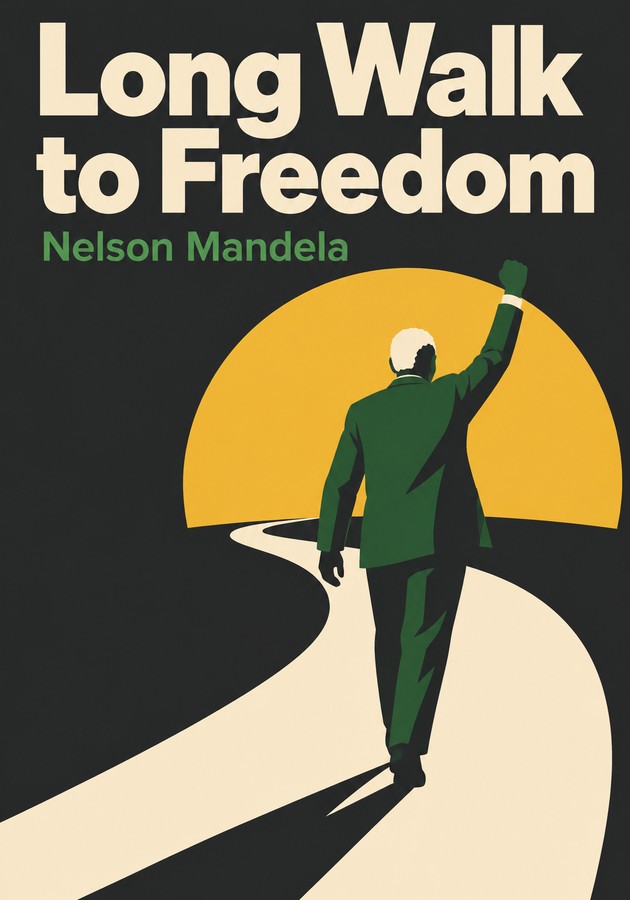
Nelson Mandela is widely considered one of the most iconic figures of the 20th century, which is why a single book (which doesn’t even cover his presidential years), even if autobiography, would never be enough to fully capture the extent of his achievements.
However, if you must read only one book about Mandela and his life, this is the book. And since the same-titled movie does little justice to its breadth and depth, watch the movie only after reading the book. You’ll see what we mean.
12min Tip
“No one is born hating another person because of the color of his skin, or his background, or his religion,” writes Mandela in one of the last paragraphs of Long Walk to Freedom.
“People must learn to hate, and if they can learn to hate, they can be taught to love, for love comes more naturally to the human heart than its opposite.” So, teach others to love; and allow yourself to be taught to love others.