Three things happened afterward. First, in 1975, Venki married Vera Rosenberry, a recently divorced woman with a daughter. “At the age of 23,” he writes, “I found myself married and the stepfather of a 5-year-old girl.” Then, a year later, he obtained a Doctor of Philosophy degree in Physics from Ohio University. And then, as soon as this happened, Venki realized that he didn’t want to do “boring and incremental calculations that wouldn’t result in any real advance in understanding.”
So, he abruptly changed his career focus and enrolled as a graduate student in biology at the University of California, San Diego. Even though obtaining a Ph.D. in physics would be considered by most people the summit of their scientific pursuit, it was merely the beginning of something bigger for Venki: he wanted to find a practical use for his physics-related knowledge. However, he chose the field of biology for a much more superficial reason: it was there that he could make himself a name and earn immortality. Why? Allow us to say something about that after introducing the second main protagonist of our story: the ribosome.
The ribosome, the ultimate code-cracker
“Mention DNA and almost everyone nods in understanding,” Venki writes somewhat despondently. “We all know – or think we know – what DNA means. It determines the essence of who we are and what we pass on to our children. DNA has become a metaphor for the fundamental qualities of almost anything. ‘It is not in their DNA,’ we say, even when referring to a corporation. But mention the word ribosome, and you will usually be met with a blank stare, even by most scientists.”
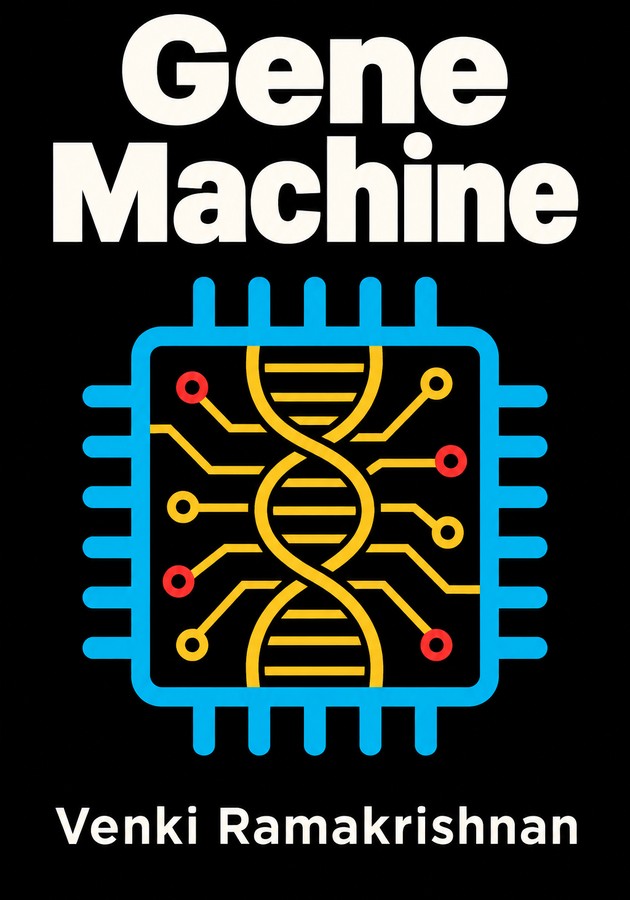
This is both pointless and scandalous, because to DNA, the ribosome is what your video codec is to the encoded digital-video file: the thing that makes sense of it all. Or, in other words, the ribosome is the DNA interpreter, the decoder, the molecular machine. The gene machine.
Strictly defined in biological terms, the ribosome is an organelle that can be found in absolutely every living cell, from bacteria to humans. It is essential for all life on Earth, and it is, consequently, just as old; the information stored in the DNA molecules would be irrelevant in the absence of a ribosome to decode it.
Writing of its importance, Venki shares an interesting anecdote. A few years ago, he was told by science journalist Quentin Cooper on the BBC radio program “Material World” that a previous guest was outraged because the eye only merited half a program while “an entire episode was planned for a mere molecule like the ribosome. “
“Of course,” writes Venki, “not only are most of the components of the eye made by the ribosome, but virtually every molecule in every cell in every form of life is either made by the ribosome or made by enzymes that are themselves made by the ribosome. In fact, by the time you read this page, the ribosomes in each of the trillions of cells in your body will have churned out thousands of proteins. Millions of life forms exist without eyes, but every one of them needs ribosomes.”
That’s why “the discovery of the ribosome and its role in making proteins is the culmination of one of the great triumphs of modern biology.” With the discovery of the DNA, we found out how the code of life is written and transferred through time. However, only after becoming familiar with the structure of the ribosome, we could reveal how this code is read and translated into the living cells that make us.
Venki and the ribosome
Now, by the late 1970s (when Venki decided to change his career focus), the structure of the DNA had already been determined and solved, primarily by James Watson and Francis Crick. However, the second part of the equation – so, how the body decodes and uses this information to pass on traits from generation to generation – was barely understood.
Just about then – in 1974, more specifically – George Emil Palade, Albert Claude, and Christian de Duve were awarded the Nobel Prize in Physiology or Medicine for the discovery of the ribosome (something Palade first did about two decades before).
Venki wanted to work on this, but he started his career in a somewhat unrelated sphere. In the laboratory of Mauricio Montal, Venki studied proteins that let ions pass through the thin membranes of lipids, which envelop all cells. However, one day, in the October 1976 issue of the Scientific American, he came across an article that would change his life. Titled “Neutron-scattering Studies of the Ribosome,” and signed by Donald M. Engelman and Peter B. Moore, the article in question “described how to locate the many different proteins on the ribosome using neutron scattering.” The interesting part: this technique was known to physicists but hardly ever used in biology.
So, due to his background, Venki was immediately intrigued and wasted no time to write to Engelman. Unfortunately, Engelman had no vacancies left at the time of the inquiry. Fortunately, the neighboring laboratory of Peter Moore had one – and the rest, as they say, is history. Especially since – and interestingly enough – Moore’s close collaborator was Thomas Steitz, Venki’s fiercest competitor in the race for the discovery of the structure of the ribosome. Four decades later, these two guys would end up sharing the Nobel Prize.
The race for the ribosome and the competitors
But first, let us introduce you to the nature of this ribosome race and the identity of the competitors that Venki was up against at the beginning of his biology career.
The objective, in more specific terms, was obtaining three-dimensional crystals or images of ribosomal particles. The prospects were somewhat bleak, mainly because the existing methods produced splotches rather than images. Venki and his colleagues explicitly and scathingly referred to crystallography as “blobology.”
But then, a pediatrician named Hasko Paradies appeared out of nowhere and published an article in which he claimed to have crystallized tRNA before anyone else. It turned out that he was lying, but, as Venki writes, “often, just being told something is possible breaks down a huge psychological barrier and spurs people to try things.”
And the people who started trying things? Well, dozens mentioned and hundreds of unmentioned and unsung heroes. Here are the few that must not be omitted from any book chronicling the race for the ribosome:
- Joachim Frank, “a tall, courteous, and somewhat reserved person with a deep love of art and literature… working away in relative isolation at the Wadsworth Center in Albany for years;” Frank won a Nobel Prize in Chemistry in 2017.
- Harry Noller, “the Sage of Santa Cruz,” a bearded, long-haired jeans-wearing guy with a fondness for motorcycles and Ferraris and the “demeanor of a mellow, pot-smoking California hippie.”
- Brian Wimberly, “the Ferrari Boy,” called that way because he rejoiced at the early maps of the ribosome just like a teenager would at the keys of a Ferrari.
- Thomas A. Steitz, Peter Moore’s close collaborator; “a burly, imposing figure” with Amishlike chin-strap beard and immense knowledge; direct in his approach and married to Joan A. Steitz, “a top molecular biologist.”
- Ada Yonath, an Israeli crystallographer with “exactly the right combination of ambition and tenacity” needed for the project.
- Venki Ramakrishnan, the dark horse of the race.
The politics of recognition and the collaborative nature of science
In 2009, the last three listed above – sometimes rivals, most of the time friends – ended up sharing the Nobel Prize for Chemistry. “I thought you had to be really smart to win one of those,” said Vera Ramakrishnan, the author’s wife, upon finding out the news. Of course, she knew a different Venki. However, there might be a deeper point hidden behind this excellent joke.
Venki constantly insists on the fact that it’s merely a coincidence that him, Steitz and Yonath – and not some three other guys – won the Nobel Prize. The reason is simple: science is a constant pursuit by the multitude and not something that an individual does or can do.
True, Venki worked tirelessly to discover the secrets of the ribosome, but so did thousands and thousands of other people, whose studies opened his – or his colleagues’ – eyes to some discovery. Precisely because of this, ever since about two decades ago, the scientific Nobel Prizes are awarded to at least three different people. “If I have seen further,” wrote Isaac Newton in 1675, “it is by standing on the shoulders of Giants.” Venki admits that he was in the same position in the 1970s; and that even if he hadn’t existed, someone else would have discovered what he did.
But that’s the collaborative nature of science: in essence, never a story of great men, but a story of the potential of human teamwork. “I don’t subscribe to the heroic narrative of science,” explains Venki further.
“Rather, some of us are fortunate enough to be the agents of important discoveries that would have been made anyway, sometimes not even that much later. But this cold analytical view does not sit well with our emotional selves. We, humans, tend to personify everything we touch. We give names to theories and theorems, discoveries, laboratories, even pieces of apparatus. Science becomes a play, with heroes and villains. So even if discoveries are inevitable, we recognize that it is individuals who make them happen, and we like to honor those who took that first leap into the unknown, to go just beyond what was thought to be possible. And when someone like Newton or Einstein sees much further than others, or Watson and Crick synthesize in one stroke the essential features of DNA that might have dribbled out in pieces, we tend to immortalize them.”
Final Notes
Part memoir, part detective story, “Gene Machine” is an engaging, wittily written, immensely important and – to quote a beloved author of ours, Bill Bryson – “beyond superb” gem of a book.
Richard Dawkins compares its “disarming frankness” (justly) to “The Double Helix”, noting that “Gene Machine” will be read and reread as an important document in the history of science.”
A profoundly human story written with honesty and humility, “Gene Machine” is something more: not only another book about a scientific discovery (in this case, the structure of the ribosome) but also a rare book that reveals how scientific discoveries are reached – and to which extent they are collaborative.
12min Tip
Read extensively and study intensively. And don’t be afraid to change your career focus: your outside expertise may be key to solving some big problems in another field of interest. Also, always prefer collaboration to separation: genius is never born in seclusion, and it only thrives in the right company.