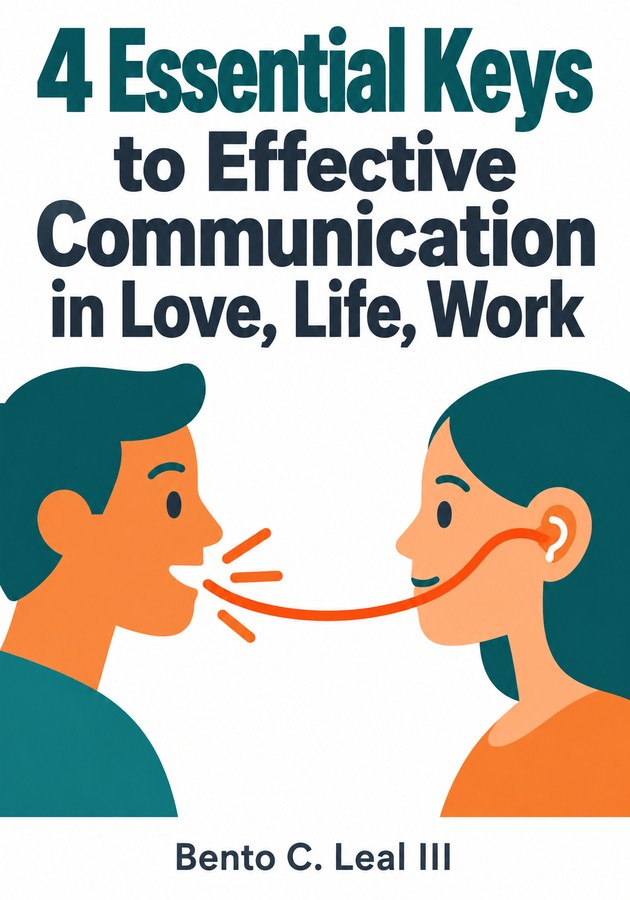
“Empathy,” writes Leal, “is a powerful state of mind, but it’s not something we try to pound into ourselves, it’s something we want to cultivate and let out – it’s our capacity to have compassion and concern for ourselves and others. Empathy is really an internal motivator to be a caring person who is genuinely concerned about the wellbeing of others, as well as one’s own wellbeing.” Empathy is also where effective communication begins. After all, unless you care about what someone is saying, you’re not really communicating with them, and you’re definitely not sharing their feelings. That’s why empathy is “the essential relationship ingredient” and the core element of all four keys to effective communication.
Key No. 1: Empathic awareness skill
Effective communication begins long before you’ve established contact with someone and opened your mouth to utter the first syllable. That’s because effective communication actually begins with something Leal calls “empathic awareness skill” which is “our internal perspective, our frame of mind, the lens, the heart through which we see ourselves and others.” Put in the simplest terms possible, it’s “the ‘why’ of communication” and “the foundational skill for all the other skills.” It’s also something that can be developed – through the following four steps:
- Recognize your own inherent value and dignity as a person. There’s a reason why flight attendants ask plane passengers to put their own oxygen mask first and then try to help someone else. Otherwise, nobody will be much help to anyone, would they? Well, it’s the same in communication: only by recognizing your own potential can you recognize other people’s. To achieve this, try reading inspirational and motivational books. Listen to speeches and sermons. Meditate. Pep yourself with some positive self-talk. Really, there are thousands of ways to enhance empathic awareness of your personal value. Do that. It’s difficult to appreciate anyone if you don’t appreciate yourself first.
- Recognize the inherent value and dignity of the other person – that they are likewise worthy of respect. Quite literally, every single person you’ve met and know is a unique human being. Moreover, there’s a good chance that all of them can teach you something and help you grow. To open yourself up to other people’s uniqueness – and more importantly to shield yourself from drifting away – use the following realignment tool: pause, reflect, adjust, act. Also, try to practice patience, forgiveness and gratitude as often as possible.
- Create the desire in your mind to want to listen and relate to them. Author Josephine Billings once said, “To the world you may be one person, but to one person you may be the world.” Never forget that. Update the Golden Rule to be more explicitly other-centered: “Do unto others as they would have you do unto them.” Leal calls this the Platinum Rule and claims it reflects the essential ingredient of interpersonal relationship: the empathy of compassion.
- Think of the positives in your relationship with the other person. The best way to want to listen and relate to someone is to focus on the positives in the relationship. Sometimes it might seem difficult but psychologists have demonstrated, on more than one occasion, that we often find precisely what we’re looking for. So, put your “empathy glasses” on and start seeing the best in other people.
Key No. 2: Empathic listening skill
In the perennial bestseller “The 7 Habits of Highly Effective People,” Stephen R. Covey remarked the following: “Most people do not listen with the intent to understand; they listen with the intent to reply.” When you listen with the intent to understand, you’re listening empathically. To master the art of empathic listening, follow these five steps:
- Quiet your mind and focus on the other person as they are speaking. Contrary to common belief, good listeners aren’t silent with their mouths – they are silent with their brains. In fact, being able to quiet your mind from distracting thoughts is the essential ingredient of empathic listening. Practice it. Remind yourself throughout the day of the importance of staying focused. Start practicing the same thing during conversations.
- Listen fully and openly to what they are saying. Listening fully and openly means listening without bias and defensiveness. It also means listening actively – not just with your brain, but with your entire body as well. Just saying, “Oh, that’s too bad” means nothing if your gestures don’t back up your words.
- Listen “through the words” to the deeper thoughts and feelings that you sense from the speaker. Most people don’t say what they mean but expect to be understood perfectly. Don’t blame them – neither language is perfect nor are we capable of using it perfectly. Instead, try to help them find the right words by listening through them. Ask for word definitions if necessary. Ask for examples and analogies as well. Don’t give up trying until you’re sure you’ve gotten the full picture.
- Don’t interrupt them when they’re speaking to you. Nobody likes to be interrupted and yet, most of us interrupt others. It’s not only annoying but distracting as well. So, don’t do it. Just listen and make mental notes! Your turn will inevitably come.
- Say back to them, in your own words, what they said, and their feelings that you sensed from them. As we already mentioned, you must make sure that you understand the other correctly at all points of a conversation. The other person will only know if they have said enough or they need to explain some more through your feedback.
Key No. 3: Empathic speaking skill
Empathic speaking is the answer to the following important question: “How can I say what I want to say in a way that accurately expresses my thoughts and feelings, and at the same time, increases the likelihood the other person will be open to hear and receive it, whether it’s a pleasant and agreeable topic or something we disagree on, or even something I’m upset about?” Empathic speaking encompasses the following five steps:
- Clarify and organize your thoughts before you speak. You know what they say: “If you blurt, you could hurt!” The reason is simple: when people feel attacked, their “fight, flight or freeze response” is activated so they can only reply in one of the following three ways – either they attack you, get defensive or remain stunned. To express your thoughts more clearly, in a non-inflammatory way, try using “I-statements” rather than “you-statements” as often as possible. Also, whenever emotions get involved, try to hit the “pause” button and spend a few seconds thinking about what you’re about to say.
- Express with respect. Be sensitive to the person you’re speaking to. Unless you treat them with respect, they will have no incentive to respond to you favorably. As Dr. Frank Luntz says, “It's not what you say, it’s what people hear.” Or, in Leal’s phrasing, “Even if you say the right words, but you say them with a disrespectful tone and attitude, the other person will hear the disrespect and not your words.”
- Express your points clearly. Most misunderstandings are rooted in vagueness and ambiguity. Expecting the other person to understand you clearly when you’re not expressing yourself clearly is tantamount to expecting them to be mind readers. So, be clear. Spell things out. And don’t just jump between points – speak about one issue at a time.
- Pause for the listener’s response. Whenever you’re done talking about a certain issue or concern, pause to allow the other person to state their mind about it. If they don’t say anything, ask them what they understood about what you said. Don’t move on to the next point unless you’re sure you’ve overcome all misunderstandings about the current one.
- Thank them for listening to you. End conversations with a simple “Thanks for listening.” It lets the other person know that you cherish their effort and that you appreciate them for it as well.
Key No. 4: Empathic dialogue
The final key to effective communication is the empathic dialogue, which encompasses going back and forth with someone else, skipping between being an empathic listener and empathic speaker. So, essentially, creating an empathic dialogue means putting empathic speaking and empathic listening together. To achieve this in real-life circumstances, you first need to practice it in a simulated environment.
To achieve this, first find an appropriate partner and decide on a dialogue topic. The tougher the topic, the better the training. If the other person is your spouse or your romantic partner, you can discuss anything from life goals to child rearing, from spending more time together to relatives and friends. If the other person is your colleague, then choose something like office frustrations, work-life balance or aspirations. Either way, try to explain to your prospective conversationalist why both of you will benefit from the practice. Then, schedule time for the discussion. Go through each of the steps. Correct each other. It’s important to take this practice as seriously as you would any other educational experience.
Now, let’s round things off with a tip from the pros. If you want to encourage and support the people in your life as often as possible, one of the best things you can do is express the 3 A’s frequently and with sincerity: applaud, admire, appreciate. Always say what it is that you applaud, admire or appreciate the person for. If you can, send an email or a letter from time to time with similar content. Life is too short to not use every opportunity to put a smile on the faces of the people that you like and love.
Final notes
Even though self-published, “4 Essential Keys to Effective Communication” became a word-of-mouth publishing phenomenon in 2017, and even made it to the top of several Amazon bestseller lists. As users say, the book’s power lies in its simplicity. Indeed, it is a brief and straightforward manual, not to mention applicable and useful. However, don’t expect anything original here. On the contrary, in fact: there’s a good chance you won’t find anything that you don’t already know in Leal’s book. So, not that great for insights, but good as a desk-side companion.
12min tip
Everyone has their own issues and concerns. Moreover, as Robin Williams said once, ”Everyone is also fighting a battle you know nothing about. So, be empathic and kind. As often as you can.”