Many people run out of steam before they even start because they burn through their entire supply of motivation describing what they intend to do. Ego loves to talk, but excellence prefers silent work.
Understand that you don't need a mythic narrative about your life to be someone who matters. What counts is the footprint you leave on the ground, not the noise you make while walking.
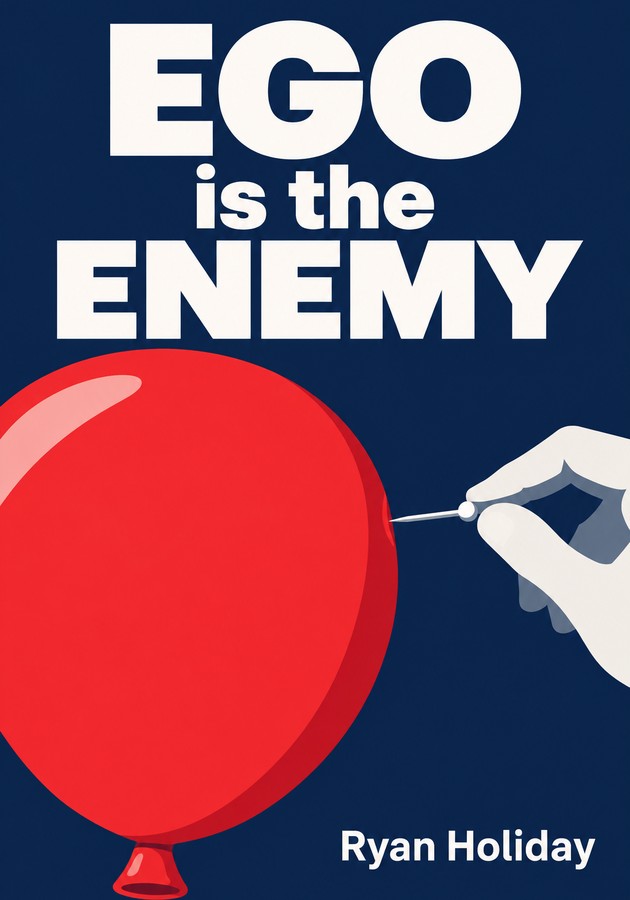
This microbook serves as a practical guide to mastering your worst adversary and keeping your head straight, whether you're climbing the mountain or coming down the other side. Over the next pages, you'll discover that the secret to a productive and balanced life isn't puffing out your chest but emptying your mind of useless pretensions.
Watch for the signs that your ambition has turned toxic. From now on, your commitment is to the truth and to the real impact of your effort.
The silent struggle of aspiration
When you're starting a project or a career, ego tries to convince you that you're a genius before you've even delivered your first result. It's the "blah, blah, blah" phase. Talking about your goals burns the chemical energy your brain should be using to execute them.
Silence is a display of strength and allows you to keep total focus on what matters.
There's a valuable lesson from John Boyd, a military strategist, who says you must choose between "being somebody" or "doing something." Being somebody means focusing on titles, positions, and public recognition. Doing something means focusing on purpose and generating real change. Ego will always prefer the title, but history remembers those who did something.
To win in this phase, you need to adopt the mindset of a lifelong learner. The moment you think you already know everything, your ability to learn dies. Place your ego below the master and below the pursuit of knowledge.
Another danger is unchecked passion. Many people confuse passion with competence, but passion often masks a lack of preparation. What leads to lasting success is methodical purpose and cold realism.
An incredible technique for staying humble and growing fast is the "canvas strategy." The idea is simple: help the people above you shine. When you clear the path for others, you end up creating your own path and earning the trust of those who've already made it.
Jackie Robinson's example in baseball perfectly illustrates the self-control required. He had to ignore brutal insults and disrespect in order to achieve a greater goal. Ego reacts to every offense, but true confidence ignores distractions.
Be careful with premature pride as well. It takes small wins and inflates them into illusions of grandeur, preventing you from continuing to grow. Remember that there's no shortcut to mastery.
Continuous, silent work is what truly separates the serious professional from the amateur who just wants to be seen.
In your next meeting, try listening twice as much as you speak. Notice how silence allows you to pick up on information your ego would have ignored in its need to be the center of attention. Try being a facilitator for other people's success this week and see how doors open with far less resistance.
The dangers of being at the top
Reaching success is a dangerous moment, because ego convinces you that your success was inevitable and purely the result of your personal brilliance. You start believing your own myths and stop doing the simple things that got you to the top in the first place.
A common mistake is constructing linear narratives about your own trajectory, leaving out the errors and the luck.
Bill Walsh, a legendary American football coach, avoided grand visions of victory and focused only on daily "Standards of Performance." He knew that if the process was right, the result would come naturally.
When you reach a position of power, ego brings an infinite desire for "more." You begin to envy people who have things you never even wanted. To avoid this, you need to define what truly matters to you. Without clear priorities, you'll get lost running someone else's race.
Power can also breed arrogance, an unhealthy need for control, and even paranoia. You start believing everything must revolve around your will.
John DeLorean, the creator of the famous car, failed because he became disorganized and too focused on his own image instead of running his company with discipline. He suffered from the "disease of me," where personal credit matters more than the collective mission.
To keep your feet on the ground, try meditating on the vastness of the universe. Realizing that we're just a tiny dot in history helps reduce the exaggerated importance we assign to our problems. Stay sober.
Angela Merkel is an example of a leader who governed one of the world's greatest powers with simplicity and mental clarity, without needing luxury or loud self-promotion.
Success demands order and the ability to delegate — things ego hates doing because it wants total control. If you lead a team, give them full credit for the next win and watch how the group's loyalty grows.
Today, examine whether you're making decisions to feed your image or to improve results. Choosing effectiveness over vanity is what ensures you stay at the top for a long time, without falling into the trap of your own arrogance.
Resilience in the face of failure
Failure is ego's trial by fire. When things go wrong, ego makes the pain unbearable and prevents you from learning the necessary lesson.
Ryan Holiday suggests you choose between "alive time" and "dead time." Dead time is what you spend wallowing, feeling bitter, and waiting for things to pass after a setback. Alive time is what you use to learn and improve, even in adverse situations.
Malcolm X is the perfect example: he turned his time in prison into alive time by studying and educating himself deeply.
You need to understand that the effort itself must be enough for you. The world doesn't guarantee recognition or applause, and you can't control how others will react to your work.
Belisarius was a general who served faithfully and was unjustly punished; he found peace because his success was defined by the effort of giving his best, not by external judgment.
Crises that destroy our self-image — those "Fight Club moments" — can be great catalysts for change. If you stop running from the truth, failure becomes the fertilizer for your next stage of growth.
Steve Jobs learned a great deal from being fired from Apple; he returned years later far more mature and effective.
Ego makes you persist in obvious mistakes just to avoid admitting you failed. Know when to stop and change direction. Have your own evaluation criteria and don't depend on other people's opinions to feel good about yourself.
Ask yourself whether you met your own standards, which should be higher than the market's.
Finally, learn to respond to disrespect with grace and magnanimity. Holding onto anger is carrying a heavy burden that only slows you down. By becoming smaller in your own eyes, you gain the freedom to do work that truly matters.
If you received harsh criticism today, don't try to defend yourself immediately. Wait twenty-four hours, analyze whether there's any truth in what was said, and use it to improve. The end of the illusion about your own importance is the beginning of your true greatness.
Final notes
Confronting ego is a daily, exhausting process of self-examination that never ends. Life isn't a monument to be admired forever but a constant field of work.
By mastering your worst adversary, you gain clarity to aspire with method, sobriety to handle success, and resilience to turn failure into learning.
The secret is to stay humble in victory and steady in defeat, always focusing on what you can do to be useful. The fight against ego allows you to see reality as it is, not as you wish it were, opening space for genuine and lasting mastery.
12min tip
To further strengthen your mindset of self-control and resilience, we recommend the microbook "The Art of Living" by Epictetus. It captures the essence of Stoicism, the philosophy that served as the foundation for Ryan Holiday's work on ego, and teaches how to focus only on what's within your control in order to achieve inner peace. Check it out on 12min!