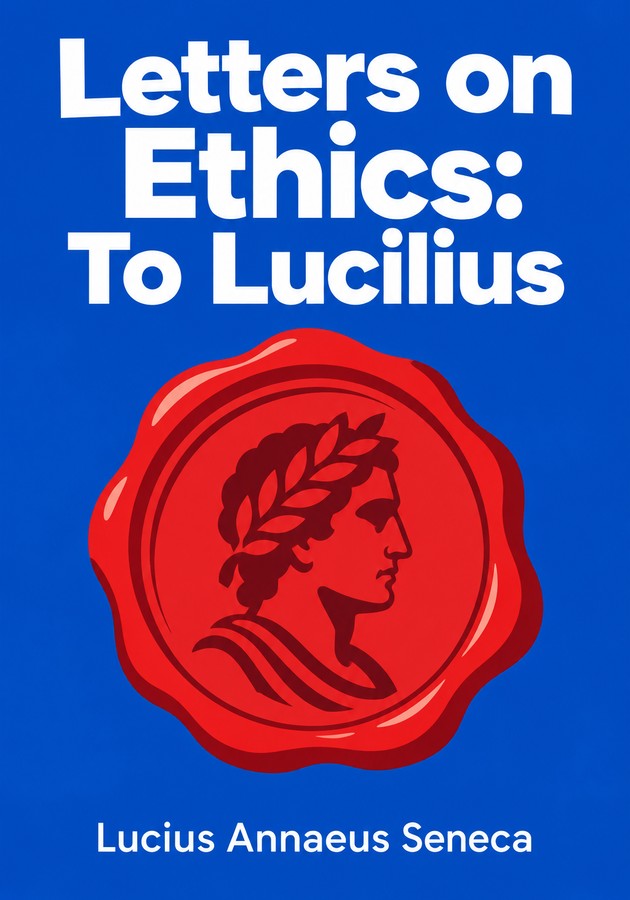
Book cover of Letters on Ethics: To Lucilius by Lucius Annaeus Seneca — critical summary review on 12min

Letters on Ethics: To Lucilius

Lucius Annaeus Seneca

5.0 (1 rating)
10 mins

Two thousand years ago, a Roman statesman facing exile and execution wrote 124 letters teaching how to actually live. This microbook distills Seneca's blunt wisdom on time, death, friendship, and wealth, showing why the only thing you truly own is the hour in front of you right now, and how to stop wasting it.

Listen to the intro

Who it is for

For anyone who feels time slipping away amid deadlines and distractions, who fears death, worries about wealth, or wonders what real friendship requires, and wants a steadier, calmer way to face daily life without pretending the hard parts don't exist.

Key Insights

Why Your Calendar Is Not Really Yours

Seneca opens not with argument but with an audit: count your hours, he tells Lucilius, because most slip away unnoticed while you assume tomorrow is guaranteed. He points to a wealthy, healthy man who died suddenly mid-plan, his construction projects and investments left unfinished, to prove long-range scheming is a fantasy. His remedy is nightly: settle every account with life before sleep, treating each day as a complete existence so nothing is left dangling when the end finally arrives.

Practicing for a Death That Cannot Harm You

Seneca treats dying not as a horror to dodge but a skill to rehearse. Since nonexistence before birth cost nothing, he argues, the same state after death should be equally harmless. He gathers proof in real lives: Mucius Scaevola held his hand in a fire without flinching, Cato chose his own end over subjugation, and Aufidius Bassus met his failing body with calm cheer. During his own near-fatal asthma attack, Seneca realized the anticipation, not death itself, does all the damage.

The False Shine of Money and Status

Wealth, Seneca insists, is not evil, just useless for the job people expect of it, and often corrosive to character. During Rome's lavish Saturnalia festival he deliberately ate coarse bread and slept on rough ground, testing poverty until it stopped frightening him. He contrasts Hannibal's army, undone by the soft luxuries of Campania after conquering the Alps, with Scipio Africanus's austere exile villa and its cold-water bath. His conclusion: true riches simply mean wanting nothing more.

Login

Login to your account

Enter your credentials to access your account

Don't have an account? Sign up

About the Author

Lucius Annaeus Seneca was a Roman Stoic philosopher, statesman, orator, and tragedian, regarded as Rome's leading intellectual figure in the mid-1st century CE. Born in Córdoba, Spain, he was educated in Rome, where he trained in rhetoric and studied philosophy at the school of the Sextii. He authored the 'Moral Letters to Lucilius' and tragedies including 'Medea', 'Thyestes', and 'Phaedra'. He served as tutor and chief advisor to Emperor Nero from AD 54 to 62.

View author profile

Lessons

  • Audit your time daily and treat each day as a complete life on its own.
  • Rehearse facing death often so its shadow loses its grip on your present peace.
  • Choose friends and company deliberately, since virtue and vice both spread through proximity.

Key Takeaways

  • Time is the only possession that truly belongs to us; everything else, including wealth and reputation, is merely on loan.
  • A virtuous act performed in joy is morally equal to one performed under torture, because circumstances are only raw material for choice.
  • Wealth and status cannot make anyone better and often make them worse, since true riches simply mean wanting nothing.

More knowledge in less time

Listen to the key ideas

We offer various commission schemes from one-time payouts.

Find your next read

12Min is very popular among readers and lifelong learners.

Good Micropaths

12Min's browser-based app works for anyone.

Frequently asked

Frequently Asked Questions

Everything you need to know about 12min

In the 12min App, we extract the best ideas and insights from the world's best-selling non-fiction books and organize them into unique, self-contained narrative summaries that can be consumed in audio and/or text in about 12 minutes!

You can download our app and start enjoying our library. If for any reason you are not satisfied with our platform, simply contact our support team ([email protected]) within 7 days of purchase and request a refund. You will receive everything you paid for, without questions or bureaucracy.

Yes, but the change will only apply from the next billing period. For example, if you decide to change your monthly subscription to an annual one, after confirming the change to the annual plan, the new plan will only be applied and charged after that month's billing anniversary.

12min Premium is a plan that guarantees you access to our entire library of 2500+ titles available in 3 languages (English, Spanish, and Portuguese) that you can read or listen to at any time through our app available for iOS, Android, and Computer. You can also read or listen to your favorite titles offline and challenge yourself with a quiz to help you retain the content at the end of each microbook.

Yes, if you decide not to renew your 12min subscription, you can cancel at any time and the next billing cycle will not occur.

Feel free to contact us at [email protected].