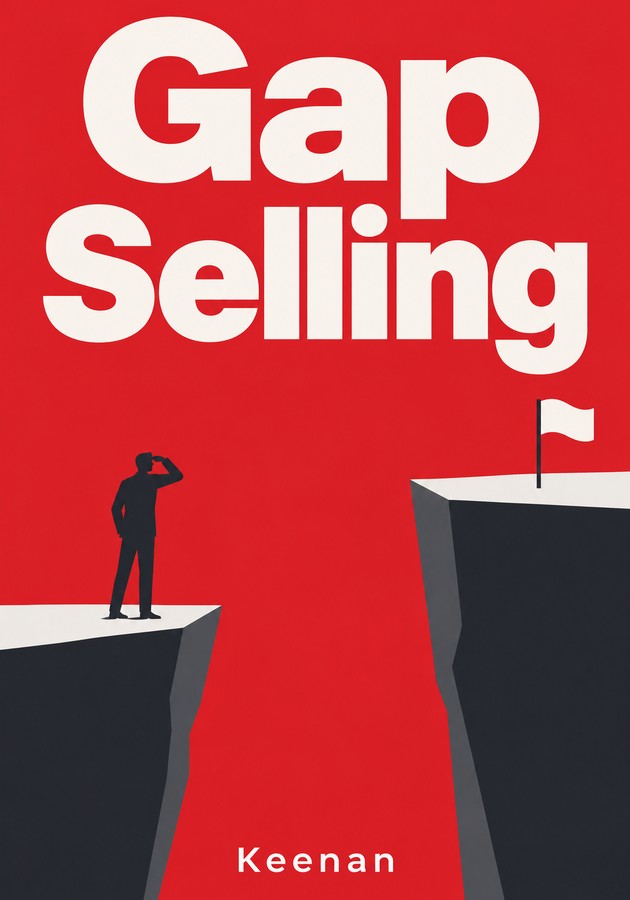
2. In every sale, there’s a gap. Customers usually don’t know the problem they have (let alone its extent) but can feel that they want to be somewhere they aren’t at the moment. The gap between your customer’s present state and their future state is where a sale actually occurs. Accordingly, every sales transaction is about identifying and outlining this gap. That’s what a seller does.
“At the heart of every sale, there’s a gap,” writes Keenan. “It’s a gap between what buyers have now and what they believe they want in the future, between who they are now and who they want to be tomorrow, or even where they are now and where they want to go. This gap represents the value of the sale to the buyer and the salesperson. Without it, there is no sale.”
The nine truthbombs of selling (No. 3-6): It’s all about change
Most customers buy things because they are not happy with the things they currently have. Some buy because they are losing money or are experiencing some sort of discomfort. Yet a third group of customers buys new things because they feel they might never move forward otherwise. Either way, the main reason why customers buy is simple: change. Change is what the next four truthbombs of selling are all about.
3. All sales are about change. As we already suggested, customers aren’t really buying products or services from salespeople, but change. Essentially, they are mainly interested in swapping their current discomfort for comfort or want something better than they currently have. It’s so essential that you understand this as a seller that we’ll repeat the main takeaway: whatever you’re selling, you’re not selling stuff or services – but change.
4. Customers don’t like change. Unfortunately, most people are afraid of change – even when they say they desperately need it. One must add here “quite unsurprisingly,” since the human brain evolved to prefer consistency and familiarity to risk and threats. Numerous studies have shown that humans suffer from longevity bias and that, in general, they attach more positive feelings toward things that have been around for a while than toward new and original things. Meaning, every sale must be a purposeful effort against habit tradition.
5. Sales are emotional. If every sale is about change, then every sale is about emotions as well, because all changes are, by definition, emotional. According to Harvard Business School professor Rosabeth Moss Kanter, there are 10 emotion-related states that cause people to resist change. They are: loss of control, excess uncertainty, surprises, too much change at once, loss of face, insecurity, extra work, the ripple effect, past resentments and real danger. You must learn how to recognize these “10 threats” because any one of them can put your customer “in an emotional state that is wholly unconducive to buying.”
6. Customers do like change when they feel it’s worth the cost. “The only way humans willingly move toward change,” writes Keenan, “is when any negative emotions they may be experiencing about that change, um, change.” Put otherwise, closing a sale is about making your customers think that the change you are trying to introduce in their lives is worth the risk of temporary discomfort. And that usually happens when you convince them that their discomfort might become permanent lest they don’t make any kind of change.
The nine truthbombs of selling (No. 7-9): Getting to the bottom
In addition to being all about the correct identification of the problem the prospective customer is facing, selling is also about a correct identification of their secret motivation to mend it. Getting to the bottom of what motivates change is what the last three truthbombs of selling encompass.
7. Asking “why” gets customers to “yes.” To unearth your prospective customer’s motivation to change, you must get to the bottom of their psyche. The surest way is through a series of why-based questions. Every answer you get can be followed with a “why” unless it reveals the original source of motivation. Put otherwise, when you get to the last “why,” you’ll also get to a tentative “yes.”
8. Sales happen when the future state is a better state. Nobody likes to change for the sake of it. To make a sale, you have to give your buyer a good reason why they should modify their habits and traditions. Meaning, you have to offer them a future state that is better than their current one and one that will unavoidably motivate them to make the switch. The three – motivation, current state and future state – always go hand in hand. You must understand your customer’s current state perfectly so that you know what kind of a future to sell them and which possibilities to include to spur them to action. There are many things that can make a future state better than the current one. The most common are: increased profits, competitive advantage, new and unexplored markets, heightened investor interest, streamlined manufacturing processes and significant savings.
9. Nobody gives a damn about you. There was a time when salespeople really mattered. It was a time when there was no easy way for a prospective buyer to research a product or a service, and a time when people actually wanted to talk to other people tête-à-tête. Keenan refers to this time as the “Age of the Tell-Me Economy.” Ever since the internet became a thing, however, we entered a new age – the “Age of the Show-Me Economy.” Salespeople who are still trying to “tell” their prospects what they do and why their products matter are just wasting their time. Prospects, essentially, don’t care about salespeople anymore. What they care about is solving their own problems. If you can offer them that – then show them the way. If not, only a time machine can save you. Long gone are the days when selling was a taking business. Now, it is essentially a giving profession.
Problem detectives (or, an introduction to gap selling)
There is a nice little joke about a Boy Scout who was so determined to do a good deed and help a little old lady cross the street that he somehow gathered the strength to pick her up and carry her to the other side. To his surprise, rather than a warm “thank-you,” he got a cold whack on the head. “But why?” – asked the Boy Scout. “Well, I never really wanted to cross the street,” replied the granny, visibly angered. “I was perfectly fine where I was previously!” If you are a salesperson, consider this a cautionary tale. Selling is not about you and your wants, but about your customer and their wishes. In other words, you can only sell what your customer needs. Finding out what the prospect needs is the essence of gap selling.
That’s why gap selling is mostly concerned with discovery. And discovery, Keenan says, must begin with “a Problem Identification Chart that lists all the potential problems you can solve, the various impacts these problems could have on your customer’s business, and their root causes.” Call the customer only after you’ve done your homework and gotten a really good sense of what their current state is and what problems you might be able to solve. Rather than telling them things during the subsequent discussion, listen and be attentive. Your goal is to discover the facts and the problems, in addition to the impact and the root cause of the latter. To achieve this, ask the following types of questions:
- Probing questions. These are “open-ended questions that press for specific details.” They should help you “record all the literal, physical facts about the business and your customer.” They give an answer to the question “why.”
- Process questions. Beyond probing questions, you will also want to ask process questions, which “try to get information on how your customers do what they do.” These are open-ended questions as well, and they mainly deal with the “how.”
- Provoking questions. These are “open-ended questions that gently push customers to consider their current state from a new perspective.” They aren’t meant just to challenge the buyer, but also to get them to think about their problems in new ways. Some provoking questions you can try are the following: “What happens when you…?” or, “Has there ever been a time when…” and, “What do you think would happen if you tried X?”
- Validating questions. Used to strengthen your relationship with the customer and check if you’ve correctly understood everything they’ve told you. These are not open-ended questions. “Am I understanding you correctly?” and “Did I get this right?” are two good examples of how they should sound. It’s important to pepper your discovery process with plenty of validating questions. That’s the only way to make sure that you’re on the same page with your buyer.
Final notes
According to Caleb Malik, sales executive at SmartBug Media, most salespeople would be better off reading “Gap Selling” 20 times than 20 different sales books one time. Even though we feel that may be a bit of an exaggeration, Keenan certainly knows how to offer value to his readers. Which is to say, he really knows how to sell. And that’s the main idea, isn’t it?
12min tip
Selling is not about you – it’s about your customer. Your job is to help them solve a problem. That’s why selling is more about diagnosing problems than it’s about presenting products and services. Remember that.