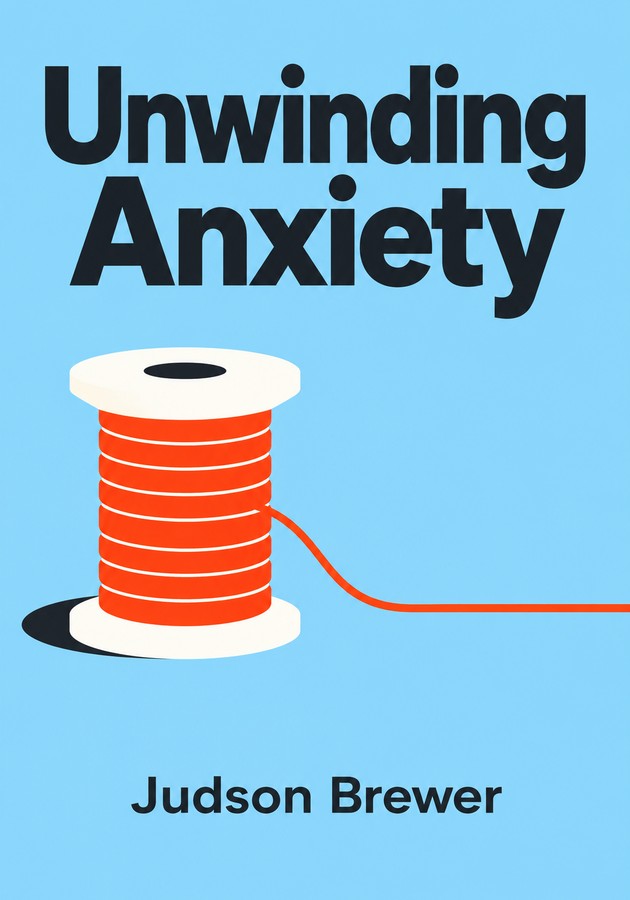
The Metamorphosis of Modern Stress
Brewer's own anxiety did not arrive as anxiety. It arrived as giardiasis. During medical school, his stomach twisted so violently that doctors hunted for parasites. There were none. The diagnosis was stress wearing a costume, and the costume fooled even him, a future psychiatrist.
That is the trick. Anxiety hides inside symptoms and routines. The World Health Organization estimates 264 million people worldwide had an anxiety disorder before the pandemic accelerated the curve. It spreads through social contagion too: a worried tweet, a frantic friend, a headline you did not need to read, and your nervous system catches the mood like a cold.
Why does the brain glitch like this? Because it was built for certainty. Fear plus uncertainty equals anxiety, and when uncertainty floods in, the prefrontal cortex, the PFC, the part that plans, simply shuts down. Starved of reliable information, it stops solving and starts spinning. The smartest part of you goes offline exactly when you need it most.
Why You Cannot Just Turn Off the Worry
Addiction, the official definition reads, is continued use despite adverse consequences. Notice that nothing in that sentence says drugs. Mental habits qualify too. So does checking your phone in line at the coffee shop, fed by what behavioral scientists call intermittent reinforcement, the same slot-machine logic that built Instagram.
Every loop has three parts: Trigger, Behavior, Reward. A bad feeling shows up. You do something. You feel briefly better. Your brain files it away as a survival tip and serves it back next time.
Worry runs on that exact circuit. The psychologist T. D. Borkovec showed that chronic worriers feel productive while worrying, as if rehearsing disaster were the same as preventing it. It is not. Worry is a mental behavior that delivers the illusion of control as its reward, and the illusion is just satisfying enough to make the brain crave another round.
Popping the Hood on Your Autopilot
Brewer teaches recovery in three gears. First gear is all about recognizing our habit loops. Nothing fancy. You watch the trigger, the behavior, the reward, and you do not try to fix anything.
That sounds passive. It is not. Traditional advice fails precisely because it leans on the PFC, and willpower is more a myth than an actual mental muscle. The moment stress spikes, the planner goes dark and the toddler brain takes the wheel.
Take Dave, a patient with crippling panic who binged on food to drown the fear. He believed his anxiety made him sharp, citing the Yerkes-Dodson Law that links arousal to performance. Brewer pushed back: correlation is not causation. People succeed despite anxiety, not because of it. When Dave finally mapped the loop, panic-trigger, binge-behavior, brief numbness-reward, he saw the eating had never solved a thing. Awareness alone began to loosen the grip.
Becoming a Student of Your Own Mind
People assume mindfulness means emptying the mind. It does not. It means changing your relationship to whatever is already there.
The brain hosts a network called the Default Mode Network, the DMN, anchored at the posterior cingulate cortex, the PCC. When you ruminate, replay arguments, rehearse worst cases, the DMN hums loudly. Brewer's lab imaged experienced meditators and watched the PCC quiet down in real time. The thoughts did not vanish. The stickiness did.
To make practice fit you, Brewer uses a Behavioral Tendencies Quiz, the BTQ, sorting people into three styles: Approach, Avoid, Go-with-the-flow. Fighters lean in too hard. Avoiders flinch. Flow types drift. Knowing your default lets you spot the move before it runs you, and tailor your practice instead of forcing someone else's prescription.
The Disenchantment Protocol
Second gear shifts the question from what you do to what your brain thinks it gets. The orbitofrontal cortex, the OFC, keeps an internal ranking of rewards based on memory. If cake soothed sadness in 1998, cake still ranks high in 2025, even if it now leaves you bloated and ashamed.
Updating that ranking is not an argument. You cannot lecture the OFC. You have to feel the aftermath. Dana Small's famous chocolate experiment fed subjects chocolate bite after bite until pleasure flipped into mild revulsion, and the brain scan showed craving and aversion lighting up the same region. Pay close attention to the back end of a habit and the spell breaks itself.
When you slip, Carol Dweck's distinction matters. A fixed mindset hears failure and curls into shame. A growth mindset treats the slip as data. Brewer's blunter name for it is FGO, a fucking growth opportunity. Replay the relapse, feel the friction honestly, and the OFC quietly downgrades the reward.
Hacking the Brain with Curiosity
Forget the 21-day myth. The Rescorla-Wagner reinforcement learning model says the brain rewires the moment a prediction error lands, the second it realizes the reward was smaller than promised. That can take ten reps or a hundred. Time is not the variable. Attention is.
Third gear is the Bigger, Better Offer, the BBO. You do not white-knuckle the old loop closed. You install something the brain prefers. Mindfulness and self-compassion qualify because they feel expansive, not punishing.
Curiosity is the secret currency. Brewer distinguishes deprivation curiosity, the itchy need to know, from interest curiosity, the open delight of finding out. Deprivation tightens the chest. Interest opens it, releases dopamine, and follows what researchers call the Goldilocks rule: just novel enough to engage, not so strange it overwhelms. Trained well, interest curiosity becomes the BBO your brain will choose on its own.
Tools for the Emotional Storm
Dave eventually used curiosity on his own panic. He stopped running from the racing heart and the tight throat and started examining them. The sensations, met head-on, dissolved. He had stepped out of the panic zone and into what Brewer calls the Growth Zone, the territory where attention expands instead of contracts.
For acute moments, Brewer teaches RAIN: Recognize the feeling, Accept or Allow it to be there, Investigate the body sensations, Note what changes. It is a structured way to surf the wave rather than drown fighting it. Brewer's team used RAIN with patients suffering binge-eating disorder, BED, and even with the U.S. women's Olympic water polo team handling pre-match nerves.
For the deeper layer, the self-hatred that fuels relapse, Brewer prescribes Loving Kindness, the Metta practice. Sending warmth to yourself softens the brain's judgment centers. Shame cannot drive a habit it no longer has fuel for.
Evidence-Based Faith, One Day at a Time
There is one more trap to dismantle. Asking why am I anxious feels productive, but Brewer calls it the Why habit loop, another rumination dressed as insight. The way out is to shift from why to what. What am I feeling, right here, in the chest, in the breath. You can even widen your eyes slightly as a somatic cue of openness.
Brewer learned this during his own panic attacks in residency, exhausted and gasping at 3 a.m. Forcing mindfulness made it worse. Objectively noting the symptoms, racing heart, short breath, tight jaw, kept a single episode from hardening into a permanent disorder.
From there, you stop trusting the method on faith. You build evidence-based faith. You track the small wins each day, the urge that passed, the loop you noticed, the breath that came back. Slowly, the body's own signals start to outvote the anxious narrator in your head. Treat it like Anderson Cooper treats sobriety, one day at a time, Anxiety Sobriety, no grand promises, just this moment chosen well.
The Next Anxious Moment
So take your next jolt of panic as a fascinating data point, not a verdict. Map the loop. Feel the friction of the old reward. Offer your brain the bigger, better offer of interest curiosity. You are not battling yourself. You are gently outsmarting an ancient system that meant well. Shift into third gear now.