The games studied by game theory are essentially well-defined mathematical objects, but are pretty limitless in scope. They include everything “from chess to child-rearing, from tennis to takeovers, and from advertising to arms control.” In fact, any interaction between two people can be considered a game worthy of mathematical analysis if it includes a set of decision-makers, a set of choices available to those decision-makers, and a specification of payoffs for each choice or combination of choices. In game theory, the decision-makers (are) involved in “a situation of strategic independence” – that is, a game – are called, appropriately, “players,” and their choices are called “moves.” A combination of moves is called a “strategy.”
Now, the moves in a game can be sequential or simultaneous. In a game of sequential moves, players take turns and have information about the other person’s previous choice before they make theirs. In a game of simultaneous moves, players must act at the same time, that is to say, they have to choose their action without any knowledge of the actions being chosen by other players.
If the interests of the players in the game are in strict conflict – that is to say, if one person’s gain always means another person’s loss – then we’re talking about zero-sum games. Such are the games in most sports competitions: if one team has won, that means the other team has lost. In practice, however, most of the games we play include combinations of mutually gainful (win-win) or mutually harmful (lose-lose) strategies. These games are called non-zero-sum games. But enough with theory: it’s time to make things much more interesting.
Sequential games: anticipating your rival’s response
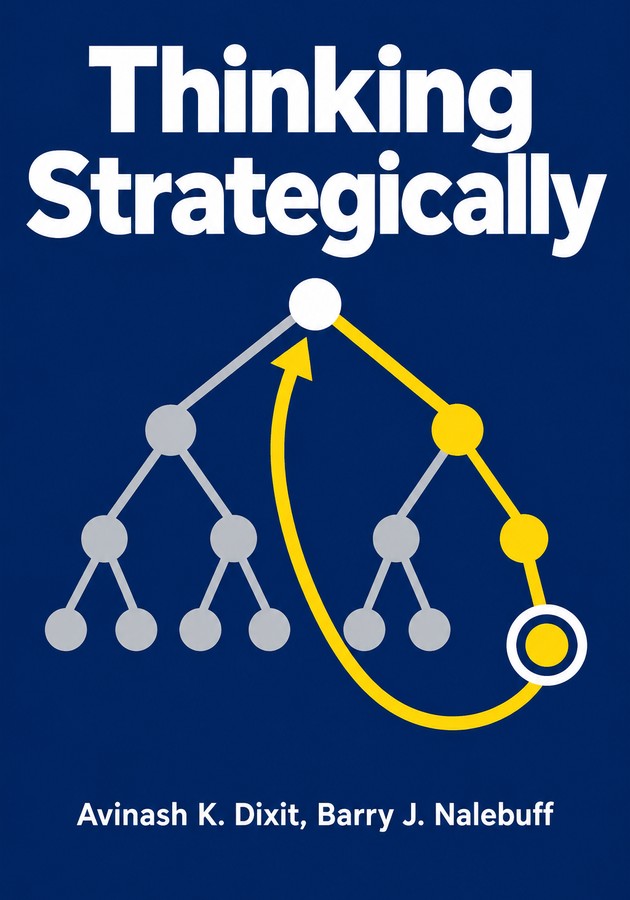
As we already said above, a game of sequential moves is a game in which players take turns. Chess and tic-tac-toe are good examples of how this kind of game works: one player makes a move, and then the other tries to find an appropriate response. Consequently, sequential games are dominated by a linear chain of thinking: “If I do this, my rival can do that, and in turn I can respond in the following way, etc.” Game theories study sequential games by drawing decision trees. The more complex the game, the more branched out the tree. The game tree for tic-tac-toe, for example, is easily searchable, but a complete game tree for chess hasn’t been drawn yet. There are just too many combinations, too many strategies.
The best choices of moves in a sequential game can be found by applying one very simple rule: “look forward, and reason backward.” In other words, “anticipate where your initial decisions will ultimately lead, and use this information to calculate your best choice.” That’s what chess players do: they ask themselves whether a certain combination will lead to a generally good position four or five moves ahead, and if so, they pursue it; if not, they try to devise another combination. Either way, they make their next move by reasoning backward from a presumed outcome several moves in advance.
To simplify the situation, think of the cartoon strip “Peanuts,” and the recurring theme of Lucy holding a football on the ground and inviting Charlie Brown to run up and kick it. At the last moment, however, she pulls the ball away and Charlie Brown, after kicking the air with full force, lands on his back to Lucy’s great amusement and perverse pleasure.
Game theorists would say that Charlie’s choice to kick the ball was never his optimal strategy and that he should have declined Lucy’s invitation immediately. Indeed, if Charlie only applies the rule “look forward, and reason backward,” he would be able to realize that there are only two possible outcomes in his situation, and that he would gain far less from kicking the ball than he might lose from Lucy pulling the ball away. Moreover, just from knowing Lucy’s character from other contexts, he should have known that the logical possibility of her letting him kick the ball was always going to be realistically irrelevant.
Simultaneous games: seeing through your rival’s strategy
Whether it’s chess or tic-tac-toe, the general principle for sequential games is that “each player should figure out the other players’ future responses, and use them in calculating his own best current move.” This principle, however, doesn’t work at all for simultaneous games (such as, say, rock-paper-scissors) wherein all players are asked to make their decisions at the same moment. As a result, simultaneous games are governed by a logical circle of reasoning: “I think that he thinks that I think that…” Moreover, whereas sequential games can be represented and studied in the form of decision trees, the best way to tackle a game of simultaneous moves is by outlining a table which would show the outcomes corresponding to all conceivable combinations of choices.
A textbook example of how a simultaneous game works is the prisoner’s dilemma. In this game, two people are arrested for a crime they never committed and put in solitary confinements with no means of communicating with each other. With not enough evidence – but a strong desire – to convict the pair, their prosecutors offer each of the innocents the opportunity to make a false confession that would implicate their unknown “collaborator.” If both prisoners do this and betray each other, they will both receive a standard sentence of 10 years. If only one of them signs a false confession, he will get away with one year of prison for cooperating with the authorities, while the other one will receive a harsh sentence of 25 years for his recalcitrance. Finally, if neither of the criminals chooses to cooperate with the police, each will be sentenced to only 3 years in prison.
The best joint strategy is, obviously, for both prisoners to stand firm. However, this is not the optimal strategy on an individual level. Quite the opposite, “the jointly preferred outcome arises when each chooses its individually worse strategy.” Individually, the best strategy for each of the prisoners is to betray the other person because, that way, in the best-case scenario, they might get a one-year sentence, and in the worst, 10 years behind bars. Standing firm, on the other hand, may result in a three-year sentence, but it can also lead to 25 years in prison. Leaving your fate in the hands of the other player is not rational. In fact, the goal of strategic thinking is the very opposite.
Dominant strategies and the Nash equilibrium
Backward induction – or, the “look ahead, and reason back” rule – is the single, unifying principle that governs sequential games. Allow us to stay with the prisoner’s dilemma a bit more – and simplify things to a certain extent – to explain the three basic rules for action that can help one devise the best strategy to win in games with simultaneous moves. These three rules rest on two simple ideas that are very important in game theory: dominant strategies and equilibrium.
A dominant strategy can be defined as a strategy that provides a better outcome for a player, regardless of the other player’s choice. In general, dominant strategies are better in some eventualities, and not worse in any. If a player finds a dominant strategy in a simultaneous game, then his decision should be to always choose it and not worry about the rival’s moves. That is Rule No. 2 of game theory, “If you have a dominant strategy, use it.”
In the prisoner's dilemma, the dominant strategy for any individual player is to implicate the other person in the crime, because that way he’ll never risk getting tricked by his rival. If both players make the same choice – that is, if both players opt for the dominant strategy – then their game will reach something called “a dominant strategy equilibrium.” This equilibrium is better known as Nash equilibrium, after mathematician John Nash, who was made famous in 2001 through the Academy Award-winning movie “Beautiful Mind.”
In a Nash equilibrium, no player can gain anything by changing only their own strategy. In other words, if one of the prisoners chooses to sign a false testimony, the best the other one can do is follow suit; otherwise, he’ll end up on the losing side. That’s why the Nash equilibrium produced by the confess-confess strategy is the dominant strategy equilibrium of the prisoner’s dilemma, even if it is not the optimal one, which is produced by mutual cooperation.
When systems fail: mixing plays
In the prisoner’s dilemma, the dominant strategy for the individual players is to cooperate and implicate the other person in the crime; standing firm, conversely, can be described as a weakly dominated strategy, because it leaves a player worse off in three of four possible cases. When a player can’t find a dominant strategy in a game of simultaneous moves, then he should apply Rule No. 3 and eliminate all dominated strategies from consideration. Finally, if there are neither dominant nor dominated strategies in a game, players should heed Rule No. 4 and look for an equilibrium, that is, “a pair of strategies in which each player’s action is the best response to the other’s.”
But what if you find no such equilibrium after careful consideration? Well, in that case, say Dixit and Nalebuff, it’s very likely that systematic behavior isn’t the solution, but the problem. The optimal approach in games of no dominant strategies or equilibrium is mixing your plays. The keyword here is not mixing, but unpredictability, or even randomness. Rotating your plays in a predictable manner is not that different from not rotating them at all.
To understand mixing better, just think of what would happen if Company A released a coupon promotion on a regular schedule, say, the last Friday of every odd month. In such a case, Company B would be able to easily preempt them by making the same move precisely a week before. Of course, then Company A can readjust its schedule to anticipate Company B’s promotions and so on. The result of the process would be less profit for both companies. However, if each of them uses an unpredictable or mixed strategy, releasing coupons at random times, both will probably gain, while reducing the fierceness of the competition.
In many sports – where systematic behavior can usually be easily exploited by rivals – the best players are those with the largest number of moves at their disposal. Simply put, it’s much more difficult to guard an ambidextrous basketball player who can both shoot and assist than it is to guard an exceptional right-handed shooter. In the latter case, the other team can concentrate solely on defending against right-handed shots. However, the more moves a player has, the less a systemic defense against him is possible.
Final notes
To quote Burton G. Malkiel, “Thinking Strategically” is “a gem of a book.” Indeed, we’ve never come across a better introduction to game theory than Dixit and Nalebuff’s classic.
“To be literate in the modern age,” remarked influential economist Paul Samuelson in a contemporary review, “you need to have a general understanding of game theory. Dixit and Nalebuff provide the skeleton key. You'll benefit from ‘Thinking Strategically’ and enjoy the book.”
We concur. On both accounts.
12min tip
Wing games of sequential move by thinking ahead and reasoning backward. In simultaneous games, try first to discern the dominant strategies. Then start using them, and stop worrying about your rival’s choices.