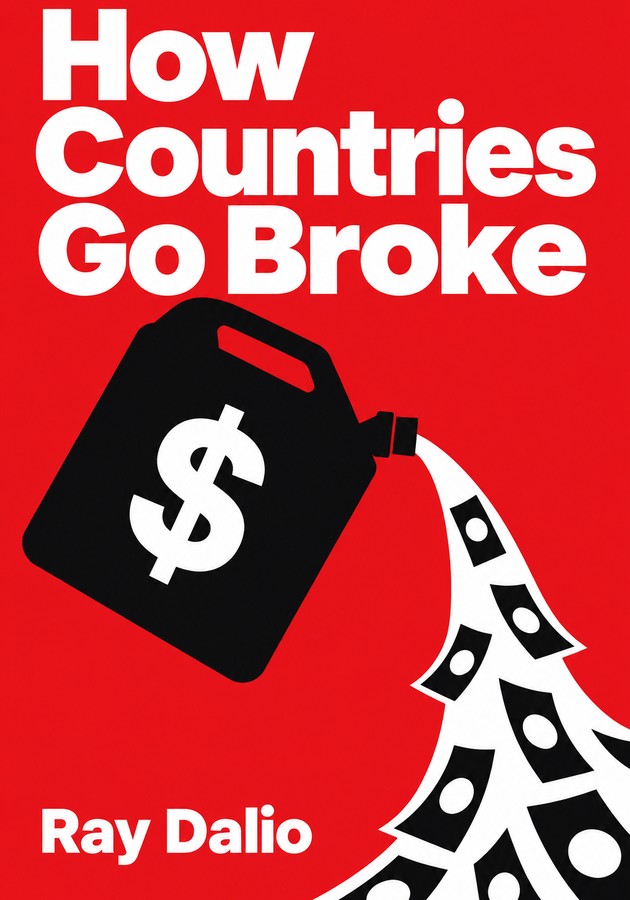
The Invisible Clockwork of Booms and Busts
Picture a friend who keeps borrowing to fund nice vacations. For a while, life looks great. The problem isn't the trip — it's that next year, he has to spend less to pay the loan back. Multiply that one person by a whole country, and you have how economies actually work.
Credit is a short-term stimulant. It fuels spending today, lifts asset prices, makes everyone feel richer. But every dollar borrowed is a future dollar that can't be spent. Dalio observed that these movements stack into short cycles of roughly six years, which compound into a long-term arc of roughly 80 years, give or take 25 years. Why so predictable? Because policy makers always lean toward stimulation. Cutting credit hurts voters now; printing more pushes the pain into the future.
The whole machine, Dalio argues, runs on five moving parts: goods, money, credit, debt liabilities, and debt assets. And prices follow a brutally simple formula — P equals dollars divided by quantity. If a central bank doubles the money chasing the same loaves of bread, bread doubles in price. The same logic explains why stocks and real estate surge whenever printing accelerates. It's not magic. It's arithmetic.
When Math Becomes a Death Spiral
Here's the moment where the music stops. As long as a country's income grows faster than the interest it owes, it can keep rolling debt forward. But the second interest rates climb above income growth, every payment eats into the next loan. The government has to borrow just to pay yesterday's borrowing.
Investors notice. They demand higher rates to keep lending, which makes the problem worse, which scares investors even more. Dalio calls this the death spiral. The only escape, in a fiat system, is for the central bank to step in and buy the debt nobody else wants — monetizing the shortfall. That works briefly, but it's gasoline on a fire.
The graceful exit, when policy makers get it right, is what Dalio names a beautiful deleveraging. It blends austerity, modest defaults, wealth transfers, and just enough money printing to ease the pain without destroying the currency. It's rare. It's hard. And it requires honesty most governments lack.
The Nine Stages of a Sovereign Collapse
Dalio studied 35 major debt crises over the last 100 years and found the same nine-stage choreography playing out, whether in Weimar Germany, 1970s Britain, or modern Argentina. He splits these collapses into two flavors: Hard Money systems pegged to gold tend to rupture overnight, while Fiat Money regimes bleed slowly across decades.
The sequence starts gently. Stage one: a healthy boom, fueled by productive borrowing. Stage two: the boom turns into a bubble, with leverage stacking on leverage. Stage three: the bubble pops, private debts go bad, and panic spreads. Stage four: the government rushes in to absorb private losses — bailing out banks, homeowners, anyone systemic enough to threaten contagion.
But governments can't just print debt forever. By stage five, free-market buyers start backing away. Net selling of government debt assets is a big red flag. By stage six, the central bank becomes the buyer of last resort. And here's the trap: if interest rates rise, the central bank loses money on the low-yield bonds already on its balance sheet. Its equity goes negative. That's the moment the currency starts to crack.
How Wealth Quietly Disappears
Stages seven through nine are where ordinary savers learn how the game really ends. Governments rarely announce a default. Instead, they pursue what Dalio calls stealth defaults: inflation that erodes purchasing power, surprise taxes on the wealthy, and capital controls that trap money inside the borders.
Why gold matters here is simple. In these severe devaluations, gold outperforms holding the local currency by roughly 60%. That's not a forecast — that's the historical average across centuries of failed regimes. Equities outside the collapsing currency tend to follow gold's lead.
And debt cycles never travel alone. Dalio insists on five most important drivers of change moving together: the debt cycle, internal politics, external geopolitics, acts of nature like pandemics and climate, and technological leaps. When extreme financial inequality meets debt exhaustion, populism rises, democratic norms erode, and autocrats sell simple answers. This is the Overall Big Cycle — economics and politics fused into one storm.
From the Gilded Age to the Nixon Shock
History rhymes. The American Gilded Age after 1865 produced electric grids, railroads, telephones, and obscene fortunes for robber barons. It also produced the Panic of 1907, then the Roaring Twenties bubble, then the 1929 crash. The Great Depression was textbook deleveraging — debts collapsed, banks failed, deflation crushed wages.
To escape, Franklin Roosevelt did something previously unthinkable. In 1933, Roosevelt outlawed the private ownership of gold, forced citizens to surrender their bullion at $20.67 per ounce, then immediately revalued gold to $35. Overnight, the dollar lost roughly 40% of its purchasing power against the metal. Stealth default, executive-order style.
The post-war Bretton Woods order tried to fix this with Monetary Policy 0 — dollars pegged to gold, other currencies pegged to dollars. It worked while America actually had the gold. But Vietnam and Great Society spending forced massive deficits, and foreign governments started cashing in their dollars for bullion. The vault emptied. On August 15, 1971, Nixon went on television and severed the link. The fiat era began.
The Era of Free Money
What followed was Monetary Policy 1, lasting from 1971 to 2008. Without gold as an anchor, central banks steered the economy purely through interest rates. The seventies brought ugly inflation — gas lines, double-digit price hikes, falling real wages. In 1979, Paul Volcker was appointed to the Federal Reserve, and he did the brutal thing: he raised rates to nearly 20%, crushing inflation and bankrupting weaker borrowers, especially developing countries that owed dollars they couldn't repay.
That cleansing set up a thirty-year leveraging boom. Rates fell steadily, asset prices climbed, and debt-to-income ratios crept higher across twelve short-term cycles. Then 2008 broke the model. Rates hit zero. The traditional tool was dead.
So central banks invented Monetary Policy 2: print money directly and buy bonds. Quantitative easing saved the banking system, but it pushed money into stocks and real estate first — into the hands of those who already owned assets. The wealth gap exploded. Then came 2020. The pandemic merged fiscal handouts with unprecedented printing, launching Monetary Policy 3. Trillions landed directly in citizens' bank accounts while the Fed bought debt at full speed. Inflation roared back. Politics turned harder, angrier, more populist.
China's Ascent and Japan's Quiet Default
Two Asian giants show how differently this script can play. China spent what it calls the Century of Humiliation under Western and Japanese domination. Then, with Deng Xiaoping coming to power in 1978, it opened markets, embraced foreign capital, and lifted hundreds of millions out of poverty. It became a manufacturing superpower.
Today, China sits on a massive internal infrastructure debt bubble — empty cities, indebted provinces, a wobbling property sector. Because Beijing owes most of this debt in its own currency, it has tools the West lacks. But its choice to confront the United States geopolitically, just as its domestic balance sheet weakens, is exactly the late-cycle pattern Dalio warns about.
Japan offers an even sharper lesson. After its 1990 bubble burst, Japan refused to let its banks fail outright. Instead, under Abenomics, the central bank kept rates near zero and bought enormous quantities of government debt — over 100% of GDP. The country never defaulted on paper. But the yen lost 60% relative to gold, and Japanese savers silently watched their purchasing power evaporate. Hidden default by currency destruction.
Reading the Dashboard on America Today
Dalio runs proprietary risk dashboards on every major economy, and the readings for the United States are flashing. Short-term, things look stable. Long-term, the country is firmly in Stage 5 of the Big Cycle — debt is 7.2x government income, the Fed's balance sheet is stuffed with low-yielding bonds bought during QE, and the deficit runs near 6% of GDP during peacetime prosperity.
His pragmatic answer is what he calls the 3% 3-part solution. The math is direct: cut the deficit from roughly 6% of GDP down to 3% by splitting the pain into three equal portions. One third comes from spending cuts. One third from tax increases. One third from lower interest rates, coordinated between the Treasury and the Federal Reserve. Done together, in calm times, the adjustment is manageable. Done in panic, after markets crack, it becomes catastrophic.
Will Washington do this? Probably not. Polarization makes any single leg politically toxic, let alone all three. And Dalio is honest about forecasting: he who lives by the crystal ball is destined to eat ground glass. Even staggering AI productivity gains, he warns, can't outrun the combined weight of debt, demographics, geopolitical rivalry, and climate stress.
What This Means for You
The machinery is cold, mechanical, unforgiving. Empires rise on productivity and drown in debt, polarization, and the illusion that paper money holds value forever. The next decade will reward those who diversify away from vulnerable fiat currencies, hold real assets like gold and productive equities outside the eye of the storm, and stop trusting that this time is different. The Big Cycle doesn't care what you believe. It only cares whether you're positioned.