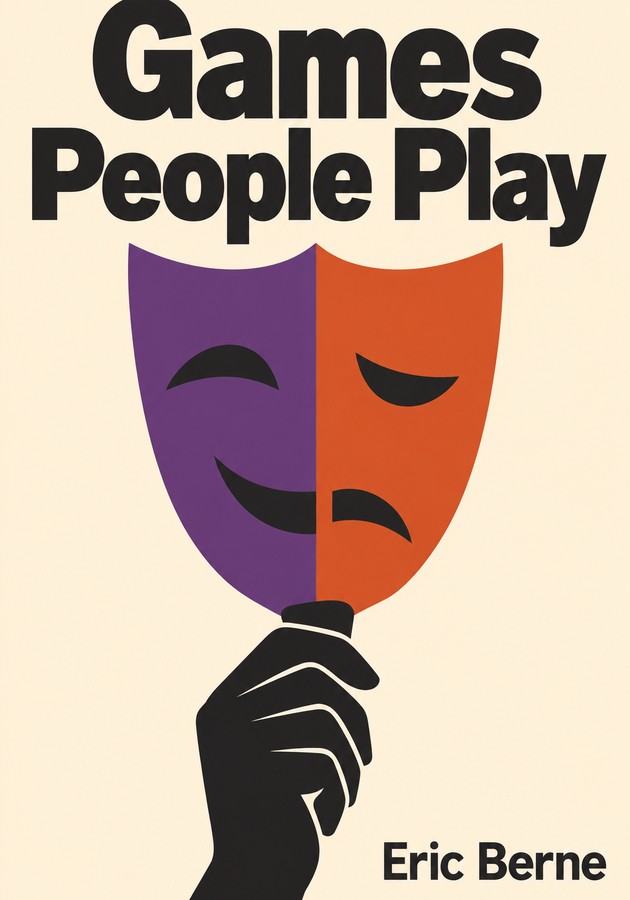
Believing that things should get a bit clearer when we move from studying individuals to analyzing their social interactions, psychiatrists after Freud further developed this idea of the divided self only to realize that William Shakespeare wasn’t merely throwing around metaphors when he wrote that “all the world's a stage, and all the men and women merely players… and one man in his time plays many parts.”
Apparently, nothing can be closer to the truth: when interacting with each other, albeit unconsciously, we are indeed actors most of the time, playing out stereotypical scripts and demonstrating “noticeable changes in posture, viewpoint, voice, vocabulary, and other aspects of behavior.” In transactional analysis, these stereotypical scripts are usually referred to as “ego-states.”
The three ego states
An “ego-state” is operationally defined as “a system of feelings accompanied by a related set of coherent behavior patterns.” However, you’ll never be wide of the mark if you think of an “ego-state” as a sort of a predefined role embedded within your personality that helps you express your feelings in the best manner possible at a given time.
Understandably – analogous to how an actor or an opera singer has a certain range – each individual has a limited repertoire of ego states available to them in their lives. Berne catalogs them in three almost archetypal categories:
Parent ("exteropsyche"). These are ego states that resemble those of parental figures. When they are “Parents,” people behave, feel, and think in a manner unconsciously mimicking and repeating the way their parents or parental figures had acted in the past. Though not directly, the Parent state corresponds to a certain level to the super-ego construct in Freud’s structural model of the psyche.
Adult ("neopsyche"). These are ego states that autonomously direct toward an objective appraisal of reality. Being an “Adult,” in layman’s terms, means acting in a grownup, mature way – which is why the objective of transactional analysis is strengthening the Adult ego states in all individuals so that they can reframe their feelings and discussions with other people at an Adult-Adult level. The Adult state corresponds to Freud’s psychic mediator: the ego.
Child ("archaeopsyche"). These are ego states that represent “archaic relics, still-active ego states which were fixated in early childhood.” So, when they are acting out their “Child” ego states, people behave, feel, and think as they have in their own childhoods. The Child state, encompassing everything from spontaneity to unbridled emotions, corresponds to the id in Freud’s model of the individual psyche.
How transactional analysis works
Now, at any given moment, in any social aggregation, each individual will exhibit a Parental, Adult, or Child ego state and will be able to shift, with varying degrees of readiness, from one ego state to another. Consequently, whenever you communicate with someone, there’s also an unconscious communication between two ego states.
When the ego states are complementary, then the social interaction (or the transaction of feelings and behavior) tends to be simple and comprehensible between any two individuals, since it follows the natural order of healthy human relationships. It is irrelevant whether the two people in question are engaging in critical gossip (Parent-Parent), solving a problem (Adult-Adult), or playing together (Child-Child or Parent-Child): in complementary transactions, communication proceeds smoothly and, in principle, indefinitely. Communication is only broken off when a crossed transaction occurs.
For example, if the husband, as an Adult, asks his wife “Do you know where my cufflinks are?” and she, as an Adult, answers “On the desk” or “I’ll help you find them,” then we have a simple, smooth, complementary transaction. However, if the wife says something like – “Why are you asking me? You’re always blaming me for everything!” then, psychologically, she isn’t replying as an Adult, but as the Child she once was, implicitly trying to force her husband to assume the role of her metaphorical father. Because of this, the real topic of discussion (the cufflinks) is suddenly suspended, and a whole other argument opens up. Until the roles realign and transaction once again are complementary, there’s no returning to the immediate problem.
In our case, either the husband becomes “Parental” as a complement to his wife’s suddenly activated Child, or the wife reactivates her Adult ego state as a complement to her husband’s Adult.
A brief thesaurus of the games we play
Interestingly enough, most of our interhuman transactions are dishonest. They are patterned, they conceal our real motivations and inevitably lead to a well-defined, predictable outcome. This is why Berne calls them games. And he uses the second part of his book to catalog almost forty different types of games that humans play with each other on a daily basis, grouping them about the environment where they are most likely to emerge. Below are the rules of some of them.
Life games
Some roles we play from time to time; others we play for life.
Consider the game “Alcoholic” for an example. On the surface, it might seem as if an Adult-Adult transaction, but, in truth, the Alcoholic is someone constantly playing the role of the “Rebellious Child.” Their goal is never to get other people to help them but to incite their anger and scolding. Afterward, they use other people’s criticisms to fuel self-hatred and this, inevitably, leads to more drinking. The Alcoholic invites their loved ones to become, unconsciously, their flawed Parents – so that they can justify transgressive behavior via self-pity and defeatism.
The “Now I’ve Got You, You Son of a Bitch” (or the NIGYSOB) game is another example of a game we tend to play throughout our lives. The unwritten rules are simple: if one has unvented anger inside them toward someone, they are on the lookout for that someone’s next mistake and, no matter how minor it is, they pounce on it with full force – just like their parents had probably done when they were children.
Marital games
You don’t need Berne to tell you that marriages are often the perfect environment for some games one can rarely play in other social interactions.
Take, for example, the “Frigid Woman” game. In it, the wife frequently sexually offers herself to her husband (by, say, walking half-naked around the house), only to reject him when he makes his move and severely scolds him for being obsessed with sex. What happens at a psychological level is a Parent-Child transaction: the wife, as if a mother, offers her cheek for a kiss, but when the husband, as if a child, enthusiastically puckers his lips and goes in, she uses the opportunity to express her pent-up anger at how unappreciated she is (once again, as the mother).
The twist is that these are roles the spouses actually enjoy. Unconsciously, the Frigid Woman wants a husband through whom she’d reinforce her prejudices toward men, and her husband is probably more interested in being teased around than in being sexually intimate with a woman.
A similar example is the “If It Weren’t for You” (IWFY) game, in which spouses accuse each other of not being where they can be in their lives because of their partners. The truth is that most of us unconsciously choose partners that might place limitations on us because this would always provide us an excuse for not pursuing the dreams that doesn’t include ourselves. We are simply replaying the Child-Parent transactions of our teenage years when we dreamed unrealistically big, and our parents tried putting us in place.
Party games
Parties are for pastimes, and pastimes are for parties – but as acquaintanceship ripens, serious games begin to emerge among the partygoers.
One of the more interesting party games is the “Why Don’t You – Yes But” (YDYB) game, the oldest one in the book. In fact, it was the first one to be dissected by transactional analysts from its social context.
It begins with a player burdened with a problem – say, a woman whose husband insists on doing repairs on his own, despite evident lack of skills. She presents this problem to a group at a party, at which moment, her interlocutors start to present solutions, each beginning with – “Why don’t you …?” In our case, they might sound something like – “Why doesn’t he take a course in carpentry?” Or – “Why don’t you buy him some good tools?” However, to each of these suggestions, the player objects with a “Yes, but…” ready to stand off the others indefinitely until they all give up.
On the surface, once again, it seems as if an Adult-Adult conversation, but YDYB is actually a transaction between a Child and a Parent. The objective of the Child – in our case, the woman with the problem – is not to find a solution, but to force her interlocutors to assume the role of Parents, so that she can repeatedly say to them “you can’t help me.” That way, she can strengthen her position as a Child laden with an unsolvable problem, allowing her to wallow in her misery and self-pity a bit longer.
Sexual games
Some of our most twisted games are, understandably, those that include our sexual impulses. Because they are usually played out in the privacy of our bedrooms, most of them cannot be demonstrated convincingly, but the rules of some are quite well established.
Such is the case with the “Rapo” game, probably the most sinister one of all sexual games. In its second-degree form (there are three variants of this game), it is basically a continuation and perversion of the Frigid Woman. It starts with a woman initiating sexual intercourse with a man and finishes with her blaming him for violent behavior after the end of the lovemaking session.
To understand what happens in this game on a psychological level, you should compare it with a scene from Charles Dickens’ “Great Expectations,” where a prissy little girl asks a little boy to make her a mud pie. However, after getting what she wants, she sneers at his dirty hands and clothing.
In both its childhood and adult version, the Rapo game is a game of guilt: the woman wants to experience being adored and irresistible but doesn’t want to accept the sexual nature of her existence. So, she transfers it to her playmate.
Final Notes
When “Games People Play” first appeared in 1964, the book was deemed one of the most original psychology books of all time. Suddenly, transactional analysis became all the rage, and, for the next three or so decades, numerous new games were cataloged and described by enthusiastic psychiatrists.
Nowadays, Eric Berne’s classic seems a bit outdated here and there, and it might even seem too Freudian and simplistic to hold off more rigorous criticism. Even so, it is still a “powerful and eye-opening” introduction to one of the most popular psychoanalytic theories and therapeutic methods ever devised.
12min Tip
Don’t take everything your partner says at face value: they might be playing a game with you, even if unconsciously. Be on the lookout for behavioral patterns, and, in time, you’ll be able to guess what your partner really wants from you – even when they are unaware of it themselves.