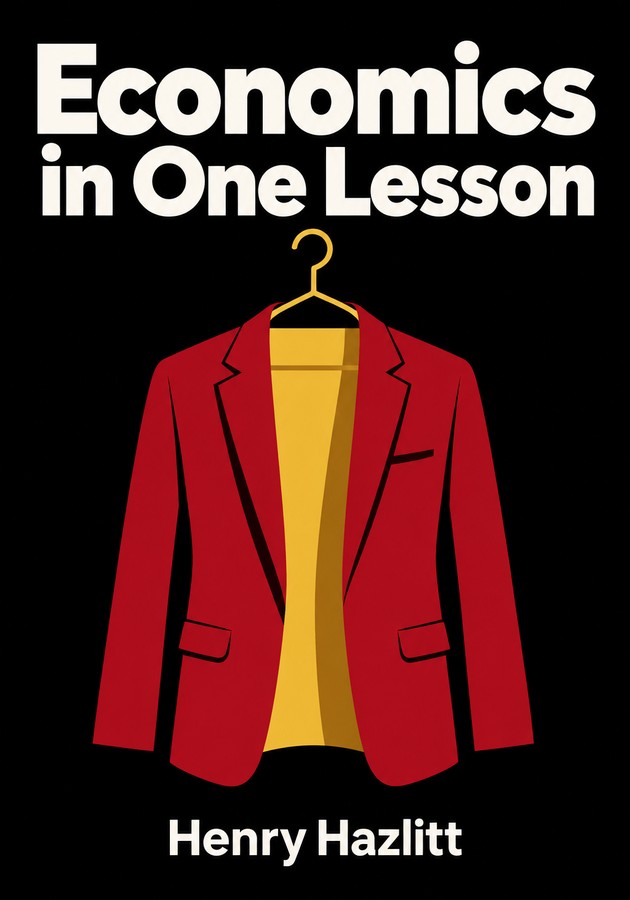
According to Hazlitt, ignoring this lesson and overlooking secondary consequences is the reason for nine tenths of the economic fallacies plaguing the world today. Because, after all, our “today is already the tomorrow which the bad economist yesterday urged us to ignore.” The bad economist, Hazlitt explains, is always concerned only with the direct consequences of a proposed course and sees only what the effect of this course has been or will be for one particular group. The good economist, on the other hand, looks at the longer and indirect consequences and also inquires what the effect of the policy will be on all groups.
Unfortunately, nobody listens to good economists because their prophecies come true years, and even decades after they are first uttered, whereas the effects of bad economic policies are observable almost immediately. To correct the half-truths of bad economists and demagogues you must supplement their chain of reasoning with the other half of the truth, you must try and bring the invisible into clear view. Let’s do that through a famous example.
The parable of the broken window
First introduced by French economist Frédéric Bastiat in his 1850 essay “That Which We See and That Which We Do Not See,” the parable of the broken window demonstrates how opportunity costs affect economic activity in ways that are largely unseen or ignored by the majority of economists. It also shows why the money spent to recover from destruction isn’t actually a net benefit to society, the opposite of which was taken for granted when Hazlitt’s book was first published, in the postwar world of substantial taxes and Keynesian economics.
Anyway, let’s say a young hoodlum heaves a brick through the window of a baker’s shop and runs away unnoticed. A crowd of people gathers around the shop and starts discussing the silver linings of the event. For example, the smashed window will inevitably lead to money and employment in the community, in ever-widening circles. For starters, if windows were never broken, glassworkers would certainly go out of business! The hoodlum’s act, on the other hand, will put about $250 in the glazier’s pocket, which he will be able to spend with other merchants who will, in turn, spend it again. All in all, the crowd concludes, far from being a public menace, the hoodlum might even be a public benefactor!
To a certain extent, the crowd is right: the broken window does mean more money and prosperity for the glazier. However, it also means less money and less comfort for the baker who will now have to spend $250 on a new window rather than on a new suit. But suits don’t just appear out of thin air – they are made by hardworking custom tailors. The money the glazier will earn because of the hoodlum is the same the tailor will lose. To make matters worse, this transaction will leave the community poorer as a whole, because even after spending $250, it will gain nothing it didn’t have before, but will have lost a beautiful, elegant, never-made-before suit.
In short, Hazlitt concludes, “the glazier’s gain of business […] is merely the tailor’s loss of business. No new ‘employment’ has been added. The people in the crowd were thinking only of two parties to the transaction, the baker and the glazier. They had forgotten the potential third party involved, the tailor. They forgot him precisely because he will not now enter the scene. They will see the new window in the next day or two. They will never see the extra suit, precisely because it will never be made. They see only what is immediately visible to the eye.”
Public works mean taxes, and taxes discourage production
As the broken window fallacy illustrates, the economy (in some ways, at least) is a zero-sum game, as spending money in one area automatically means not spending it in another. However, since what is sacrificed remains invisible or unseen, the ways money is not spent is usually only scrutinized by good economists. This is why only good economists know that government subsidies and public works are shortsighted policies that benefit only some groups and harm the community as a whole.
“Everything we get, outside of the free gifts of nature, must in some way be paid for,” writes Hazlitt. In other words, whatever is paid for by the government, be it a road or a bridge, is actually paid for by a group of individuals through their taxes. The “government,” the “collectivity,” the “nation” are all just abstract terms that make people forget or ignore the individuals who comprise the groups and actually give these words their meaning. In truth, for every dollar a construction worker gets from the government for building a bridge, a dollar is taken away from a taxpayer who would probably have spent it on something else and, accordingly, contributed to the prosperity of another business. By discernibly creating jobs in one part of the economy, the government undetectably generates job destruction in another. In general, there is no net benefit, since no employment or wealth is actually added.
In fact, if anything, the opposite happens. Taxing inevitably affects the incentives of those from whom the money is taken. Even though a corporation loses 100 cents of every dollar it squanders, it keeps only about 60 cents of every dollar it gains. As a result, it doesn’t expand its operations to the extent it would have if it had been taxed less, nor does it invest into improved machinery and better-equipped factories as much as it could have if it kept, say, 85 cents of every earned dollar. Consequently, the corporation employs fewer people, real wages are surreptitiously held down, and consumers are, unknowingly, prevented from getting cheaper and better products in shorter periods of time. By trying to solve the problems of poverty and unemployment the Keynesian way – by way of taxing and spending – the government, in fact, exacerbates them. To make matters worse, it is usually praised for it!
A curse in disguise: government encouragement to business
Let’s now move on to some other types of government incentives, such as subsidies, credits and different kinds of government loans. In essence, they seem like a blessing – after all, everybody’s after them. However, just like most other government policies, they are actually curses in disguise.
First of all, whether private or public, every loan must eventually be repaid by someone. Therefore, writes Hazlitt, “proposals for an increased volume of credit […] are merely another name for proposals for an increased burden of debt.” They seem like a good thing only because, instead of being scrutinized from the standpoint of the community as a whole, the matter is only seen from the standpoint of the companies or individuals who receive the loans – say, dying industries or poor, hardworking farmers.
If you are a private lender, you risk your own capital when you are lending someone your money. That’s why you are incentivized to make greater effort in screening, structuring your risk and securing collateral. However, if you are a public lender, you are allowed to give money to anyone. In fact, governments are usually encouraged to give money to the ones who are unable to loan privately and, thus, assume the risks that are “too great for the private industry.” In other words, the government is allowed to take risks with the money it gets from your taxes that you would never be willing to take with your own money.
You are, simply put, coerced into subsidizing bad risks. Even worse, so are some very successful companies. Hence, in Hazlitt’s words, “when the government makes loans or subsidies to business, what it does is tax successful private business in order to support unsuccessful private business.” The same happens when it tries to “save” a domestic industry from collapse by special tax breaks or preventing new entrants in an “overcrowded” market. From the standpoint of the country as a whole, in both cases, the government is actually opposing progress; because destruction is a necessary part of progress. Subsidizing an unsuccessful private business or a failing industry is akin to attempting to keep the horse-and-buggy trade from downfall even after the automobile was invented. Do that and everybody loses in the end.
The proper role of the government
When Alexander the Great happened upon the Greek philosopher Diogenes the Cynic in Corinth in 336 BC, he asked him if there was anything he could ever do for him. “Yes,” replied Diogenes, “you can stand a little less between me and the sun.”
In Hazlitt’s opinion, this is what every citizen should request from their government. Instead of asking for more loans and subsidies, minimum wages or redistribution of wealth, people should demand the encouragement and preservation of a free market and the creation and enforcement of “a framework of law that prohibits force and fraud.” Nothing more, nothing less.
Because, in essence, economics is a rather simple science: meddle less and everybody gains more. Giving people things for free, saving dying industries, controlling rent and wages, and paying money to individuals who don’t produce while heftily taxing those who do has never (and will never) bring positive results for any community. History says so.
Final notes
“Economics in One Lesson” by Henry Hazlitt is a short and simple introduction to the “dismal science.” Even though many readers might be put off by its conservative and libertarian bent, the book’s one lesson seems so commonsensical it’s fascinating that governments and economists have still not learned it.
But that is why Hazlitt’s primer on economics is still relevant. And it will continue to be so until its main lesson becomes commonsense wisdom.
12min tip
Whether in economy or in life, there are short and long-term consequences of any action. Being hypnotized by the immediate results means either being erroneous in your judgment or being misled. Don’t allow yourself to be either.