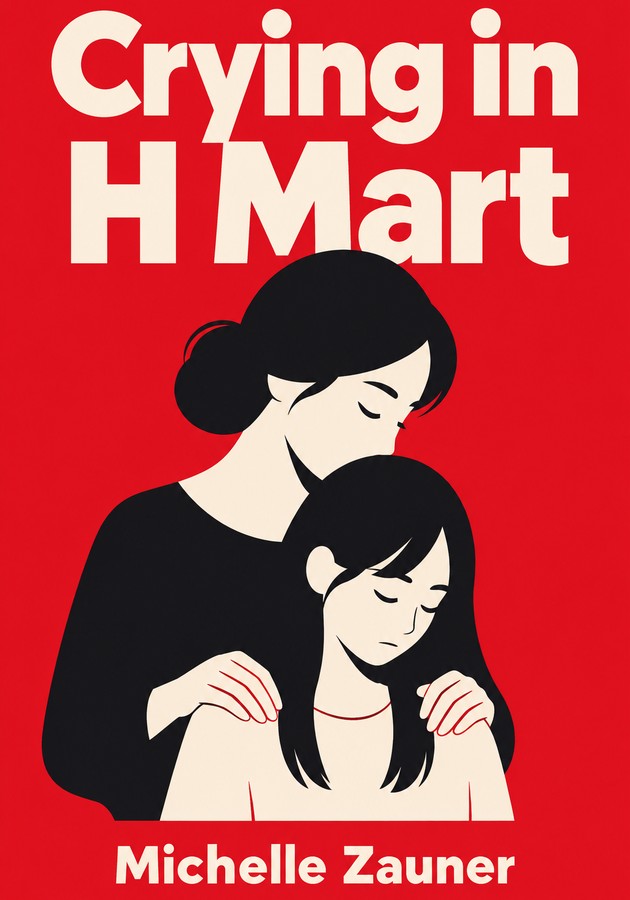
In 1983, Michelle’s father flew to South Korea in response to a simple job ad that said “Opportunity Abroad.’’ It turned out the opportunity was a training program in Seoul, selling used cars to the U.S. military. The first Korean woman he met worked at the front desk of a hotel he stayed at. It was also the woman he would marry three months later, have a baby with, and move to Eugene, Oregon, a small town full of hippies and greenery. As a child, Michelle did not appreciate these features much - the house in the woods meant she was far from convenience stores, parks, and other children she longed to play with. ‘’I was stranded and lonely, an only child with no one to talk to or turn to but my mother,’’ she remembers.
Since Michelle’s mother was a housewife, and therefore at home most of the time, being left with her in the woods meant not only loneliness but being overwhelmed by her time, attention, overprotectiveness, as well as devotion that could be both ‘’an auspicious privilege and have smothering consequences.’’ She had high expectations of her daughter and always tried to shape her to be the most perfect version of herself, which was usually exhausting for Michelle, who always desperately tried to please her mother. However, as an adult, Michelle isn’t resentful of her mother’s behavior. She says, ‘’She was guilty only of caring too much. I realize this now, only in retrospect. No one in this world would ever love me as much as my mother, and she would never let me forget it.’’
‘’I’m just waiting for you to give this up’’
When she was a high school student, Michelle became passionate about music. ‘’Nothing was as vital as music,’’ she realized, ‘’the only comfort for my existential dread.’’ She spent most of her days downloading songs one at a time off LimeWire, analyzing lyrics in the liner notes, reading interviews with stars of Pacific Northwest indie rock, figuring out which concert to attend, and discussing on AIM the music matters, such as whether the Foo Fighters’ acoustic version of ‘’Everlong’’ was better than the original. One musician particularly impressed her - Karen O, the front woman of the ‘’Yeah Yeah Yeahs’’ who was half Korean and half white, ‘’with an unrivaled showmanship that obliterated the docile Asian stereotype.’’ She made music more accessible to Michelle, and, perhaps, more importantly, made her believe that an Asian girl like her could one day make something meaningful to other people.
When she got a Yamaha acoustic guitar as a Christmas present from her parents, Michelle started taking music lessons once a week. She also had a guitar teacher at school - Nick Hawley Gamer, a cool boy with whom she had English classes. Nick had his own band and was helping Michelle play. Also, he encouraged her to record the songs she wrote in a studio. Her mother wasn’t particularly happy about Michelle’s passion for music. As Michelle notes, this became ‘’a chasm that threatened to swallow us whole.’’ Once she told her mother she wanted to record songs in a studio, she responded, “I’m just waiting for you to give this up.” “I should have never let you take guitar class. You should be thinking about the colleges, not doing this weird thing.” As you may assume, these remarks were the beginning of their fight, which ended with Michelle going away from home for a few days. She couldn’t care less about the college at the time, so in the end, her mother sent applications to the colleges Michelle was previously interested in. Luckily, she got accepted to one of them, and so did the new chapter in her life begin - she could finally start building her life independently of her mother.
The day everything changed
To Michelle’s mother, Americans seemed overly cautious and overly medicated to her. She rarely went to doctors, believing that ailments passed of their own accord. Therefore, when Michelle heard she went to hospital for a stomach ache, she knew it had to be something serious. After a dozen unanswered texts and calls, her mother finally called her to tell her what was going on. “They found a tumor in my stomach,” she said. “They say it’s cancerous, but they don’t know how bad it is yet. They have to run some more tests.” Unfortunately, the test results were not promising.
When she found out about her mother’s diagnosis, despite her objections, Michelle quit all three jobs she had back then, sublet her apartment, and put the band on hiatus. She wanted to spend the summer at her parent’s home to take care of her mother. ‘’I fantasized about the delicious food we’d make together, finally repaying my debts, giving back some of the love and care I’d taken for granted for so many years.’’ Apart from returning home, Michelle also decided to do one more thing - get married. Although she was in a happy and stable relationship then, the wedding wasn’t on her mind. However, she knew she did not want a ceremony without having her mother beside her. ‘’In fact, the only thing I’d always known was that if I ever did get married, my mother would be the one who made sure it was perfect. If she wasn’t there, I was guaranteed to spend the day wondering what she would’ve thought,’’ she writes. ‘’It’d be impossible to feel beautiful without her approval. If she wasn’t there, I knew I was destined to be a joyless bride.’’ When she proposed the idea to her boyfriend Peter while they were talking on the phone, he was on board with it. After hanging up, she went to her mother’s room to tell her she had to get better to watch her only daughter get married.
A new chapter in Michelle’s life
“Umma, are you there?” Michelle whispered. “Can you hear me?” “Umma, please wake up,” she yelled. “I’m not ready. Please, Umma. I’m not ready. Umma! Umma!” As she sat by her mother, who was unconsciously lying on the bed, Michelle called her in Korean, hoping she would wake for a moment and hear her. Open her eyes and say goodbye. Say something that would help her move forward. ‘’Above all,’’ she writes, ‘’I wanted so desperately for her last words not to be pain. Anything, anything at all but that.’’ But, her mother showed no signs that she heard her daughter.
Later that week, while she was sleeping in her childhood bed with her husband Peter, her father woke her up. ‘’Michelle, it happened,” he whimpered. “She’s gone.” Then, Michelle went to her room. Her mother looked the same as she had the past few days, supine and still. As she sat on her bed beside Peter, she thought how cyclical life was. There they were, Peter and her, freshly married, on the beginning of a new chapter in life, and her father, now a widower, sitting beside a corpse, ‘’closing the book on over thirty years of marriage.’’ Her father took the wedding ring from her mother's hand and gave it to Michelle. She put it on her finger but felt weird about wearing it. She writes, ‘’I twisted it back and forth, trying to get comfortable, its facets glistened in the light of breaking dawn, oversized and out of place on my undiscerning finger. It felt heavy. A weight emblematic of loss, a tug I’d notice every time I went to lift my hand.’’
As the day of the funeral approached, everything was arranged. They decided to bury the urn with her ashes at the cemetery, as Michelle wanted a place where she could come and bring flowers. All that was left to do was write a eulogy, which was particularly challenging. How could she write about someone she knew so well? What could she say to reveal that she was so much more than a housewife, a mother - that she was a spectacular individual?
Coffee Hanjan
After her mother’s death, Michelle and Peter moved to New York, where Michelle got a job at the advertising company. She wanted to put her creative ambitions aside and pour her energy into climbing the corporate ladder. Nevertheless, a series of events indicated that her path would be different than she initially planned. Upon release of their record, her band ‘’Japanese Breakfast’’ to her surprise, received lots of attention. Also, ‘’Glamour’’ magazine chose her essay titled ‘’Love, Loss and Kimchi’’ as the best one that year. As a reward, they published it, arranged a meeting with a literary agent, and gave her $5,000. Around the same time, she was offered a five-week tour opening for Mitski across the United States.
Thanks to the album’s success, Michelle could pursue music full-time for the first time in her life and, therefore, decided to quit her job. Her husband soon joined the band on lead guitar, and they started traveling across the U.S., Europe, and Asia to hold concerts. The last on the map on their tour in Asia was the city where she was born. As she got on stage in Seoul, she wished that her mother could see her and be proud of the woman she’d become and the successful career she’d built, ‘’the realization of something she worried for so long would never happen.’’
On the last night of their stay in Seoul, Michelle, and Peter went to a karaoke bar with Michelle’s aunt Nami and her husband, Emo Boo. As the lead line of ‘’Coffee Hanjan,’’ one of the songs Nami chose to sing, appeared on the screen, Michelle realized she had heard it before. Perhaps her mother sang it years and years ago. As the song progressed, she swayed back and forth with Nami, chasing Korean characters on the screen and trying to sing along in the hope that her mother tongue would guide her.
Final Notes
Perhaps H Mart won’t make you cry, but this book certainly will, especially if you lost someone you loved or can relate to a complicated mother-daughter relationship. As Dani Shapiro, author of ‘’Inheritance,’’ wrote, ‘’In this beautifully written memoir, Michelle Zauner has created a gripping, sensuous portrait of an indelible mother-daughter bond that hits all the notes: love, friction, loyalty, grief. All mothers and daughters will recognize themselves—and each other—in these pages.”
12min Tip
We often don’t appreciate the presence of our loved ones enough in our lives. Life is fragile, and sadly, they could be gone anytime. Therefore, be kind to them, tell them how much they mean to you, and cherish the moments you spend together.